Which keywords should I look at first?
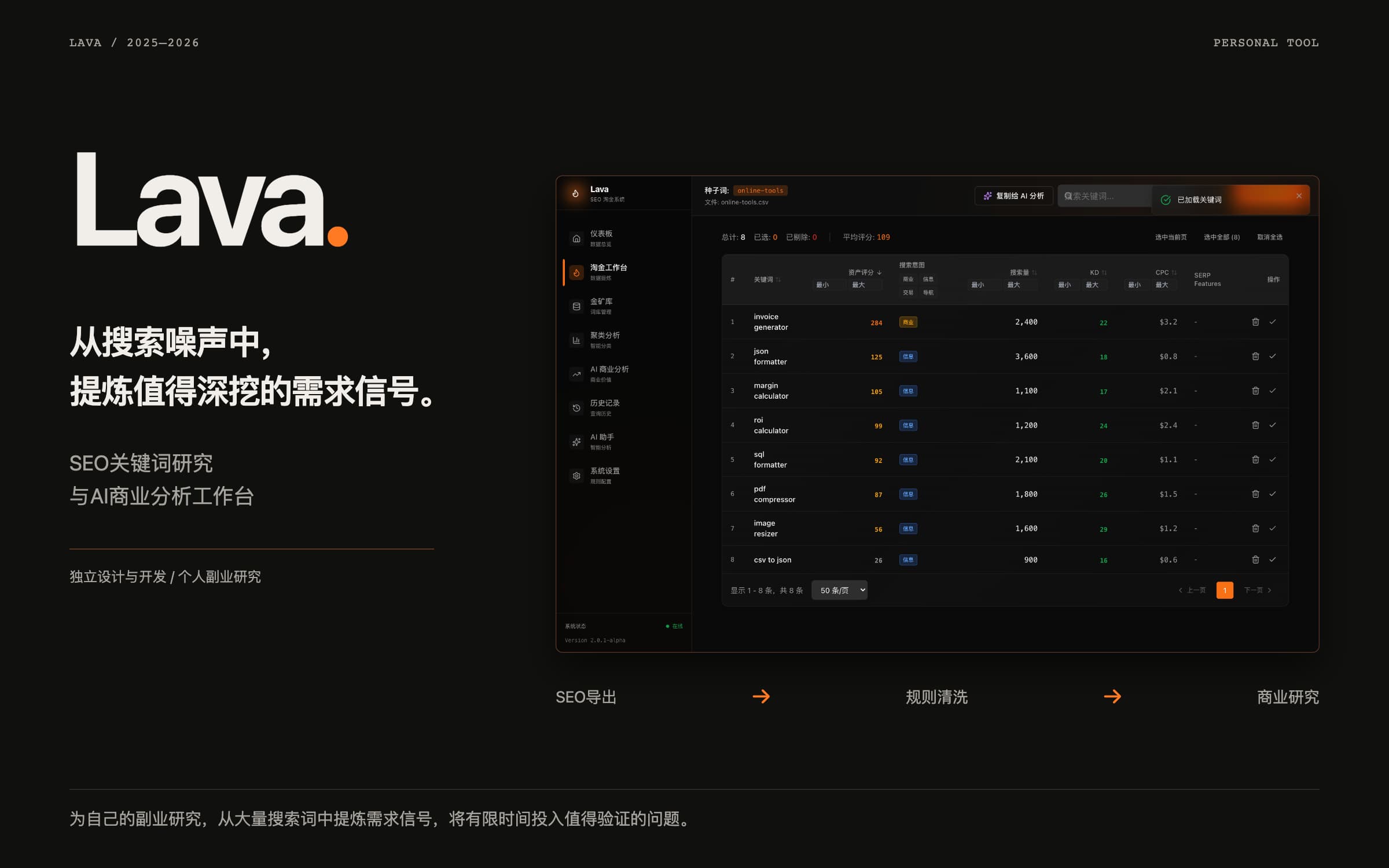
Lava is a keyword research workspace I independently designed and built for my own side-project research. It cleans SEO exports, identifies demand signals, and uses AI to explore willingness to pay, usage frequency, and pain points.
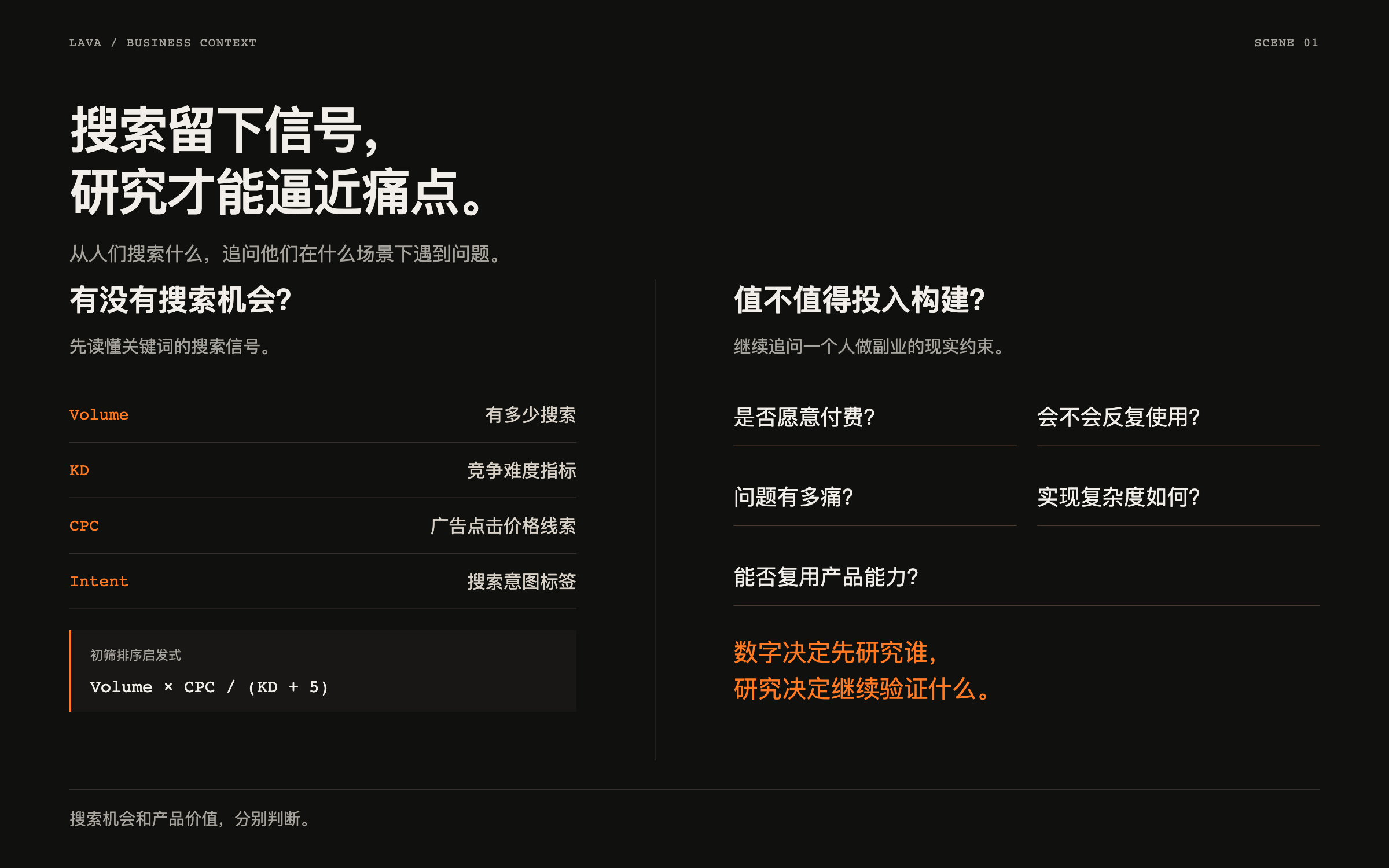
Search volume, difficulty, and CPC provide useful clues. They cannot tell me whether someone will pay, return regularly, or need a product I can reasonably build. Lava turns that gap into a repeatable research process.
What search metrics leave unanswered
A low-difficulty keyword may describe a one-off question. A popular term may lead to an established platform, a physical product, or a business outside my scope. Conversely, an informational query may be someone looking for a specific tool.
I separated search opportunity from the value of building a product. Cleaning surfaces relevant signals; deeper analysis asks who has the problem, in which situation, and how often it occurs.
Screening rules and exceptions
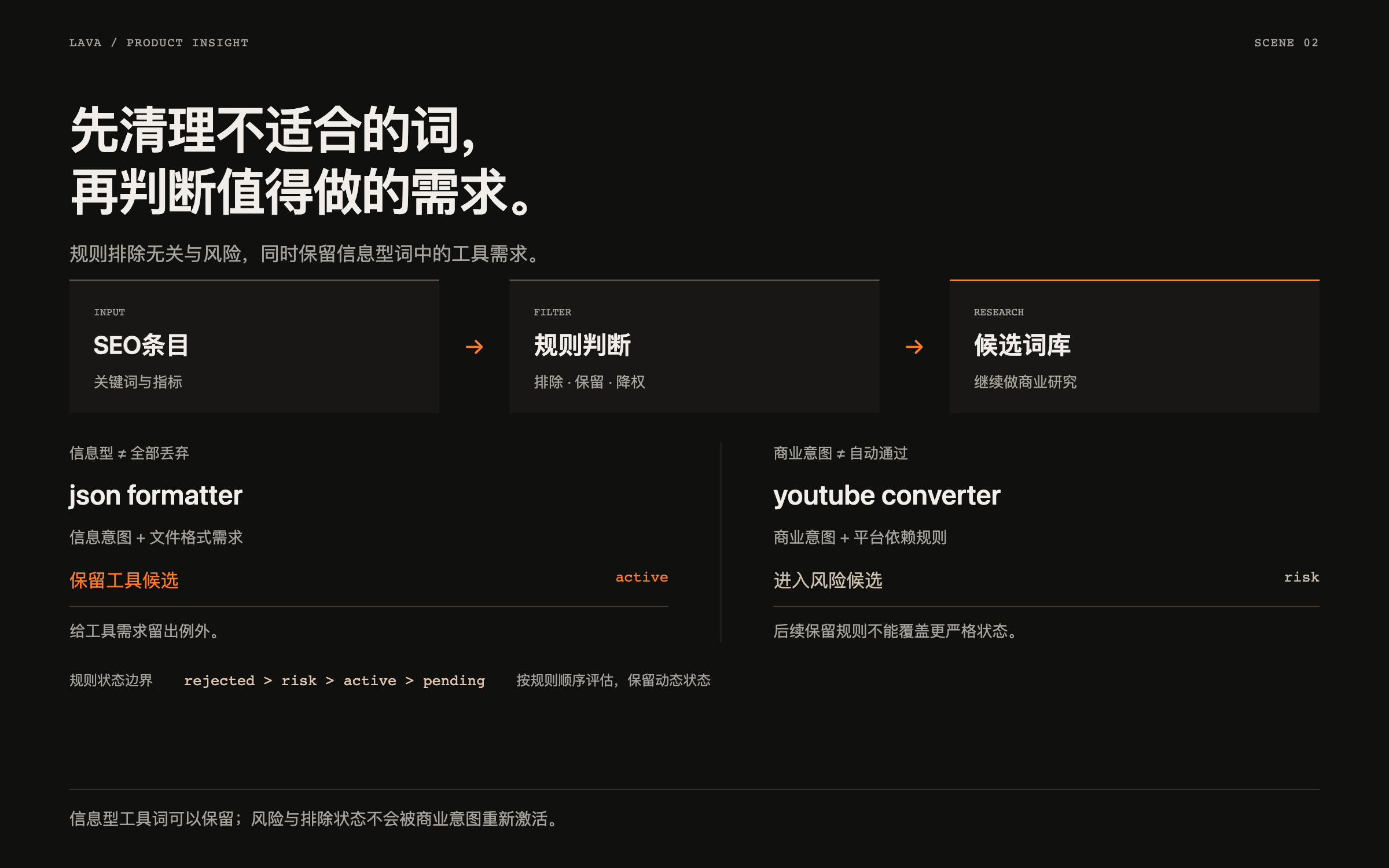
Editable rules remove irrelevant and high-risk entries while preserving tool-related informational queries. Exclusion and risk states take precedence, so a later commercial-intent rule cannot reactivate them.
Volume, CPC, and difficulty provide an initial research order. That score helps decide what to inspect first; it does not predict revenue.
Saving each research session
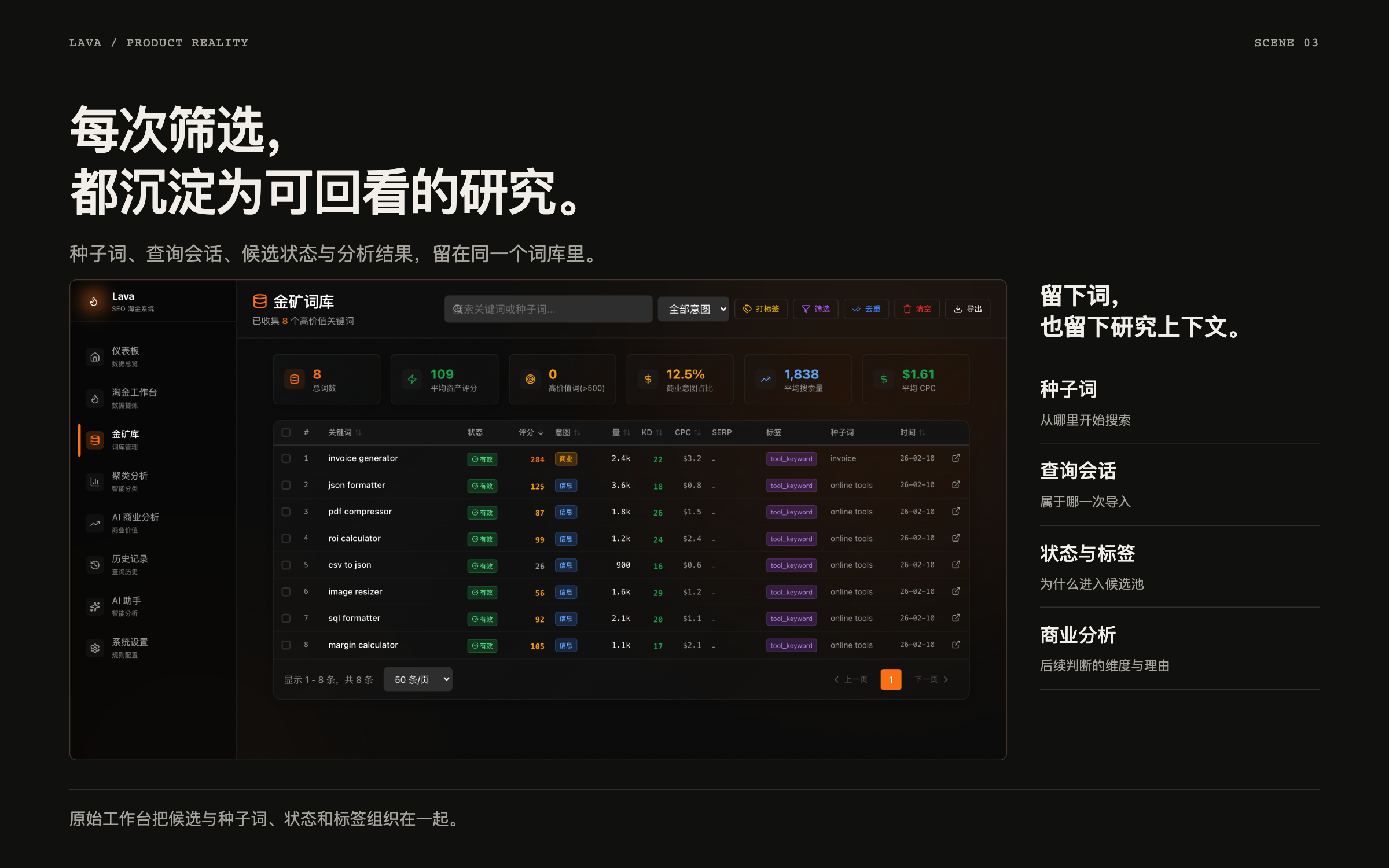
Each import retains its seed terms, source file, and research session. Candidates enter a shared library with their status, tags, and subsequent analysis.
The next export extends the same research asset. Earlier candidates remain available for comparison, and their source can still be revisited. Cleaning, saving, and analysis belong to one continuing process.
The dimensions in AI analysis
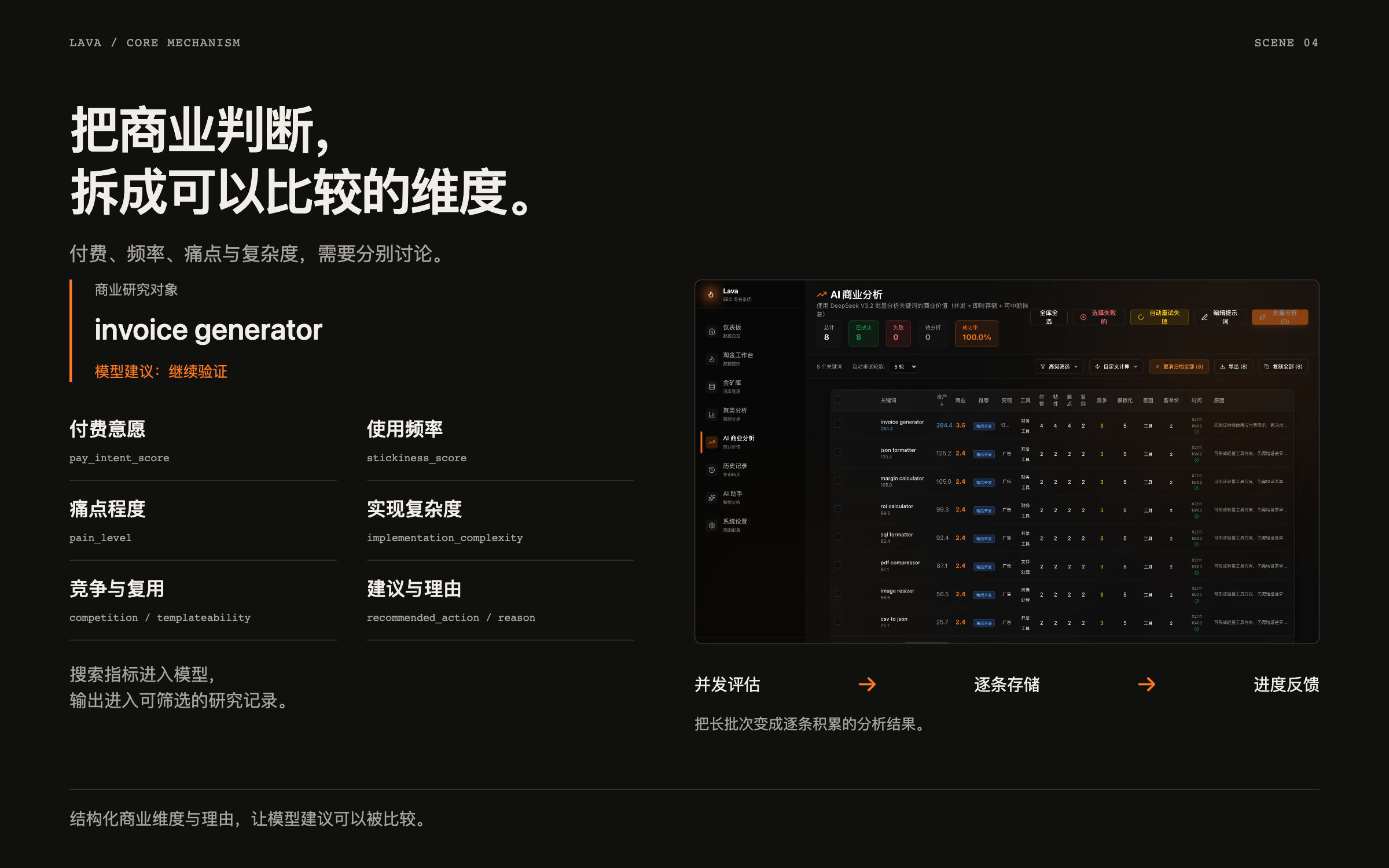
AI analysis considers willingness to pay, frequency of use, pain points, implementation complexity, competition, and how repeatable the product could be. It returns structured dimensions, explanations, and suggested actions from the keyword and its SEO context.
Rather than accepting another overall score, I can ask why a candidate was retained and whether it suggests a subscription product or a lightweight tool. Batch results are saved individually and accompanied by progress feedback, so research can continue before the entire batch finishes.
Grouping related product needs
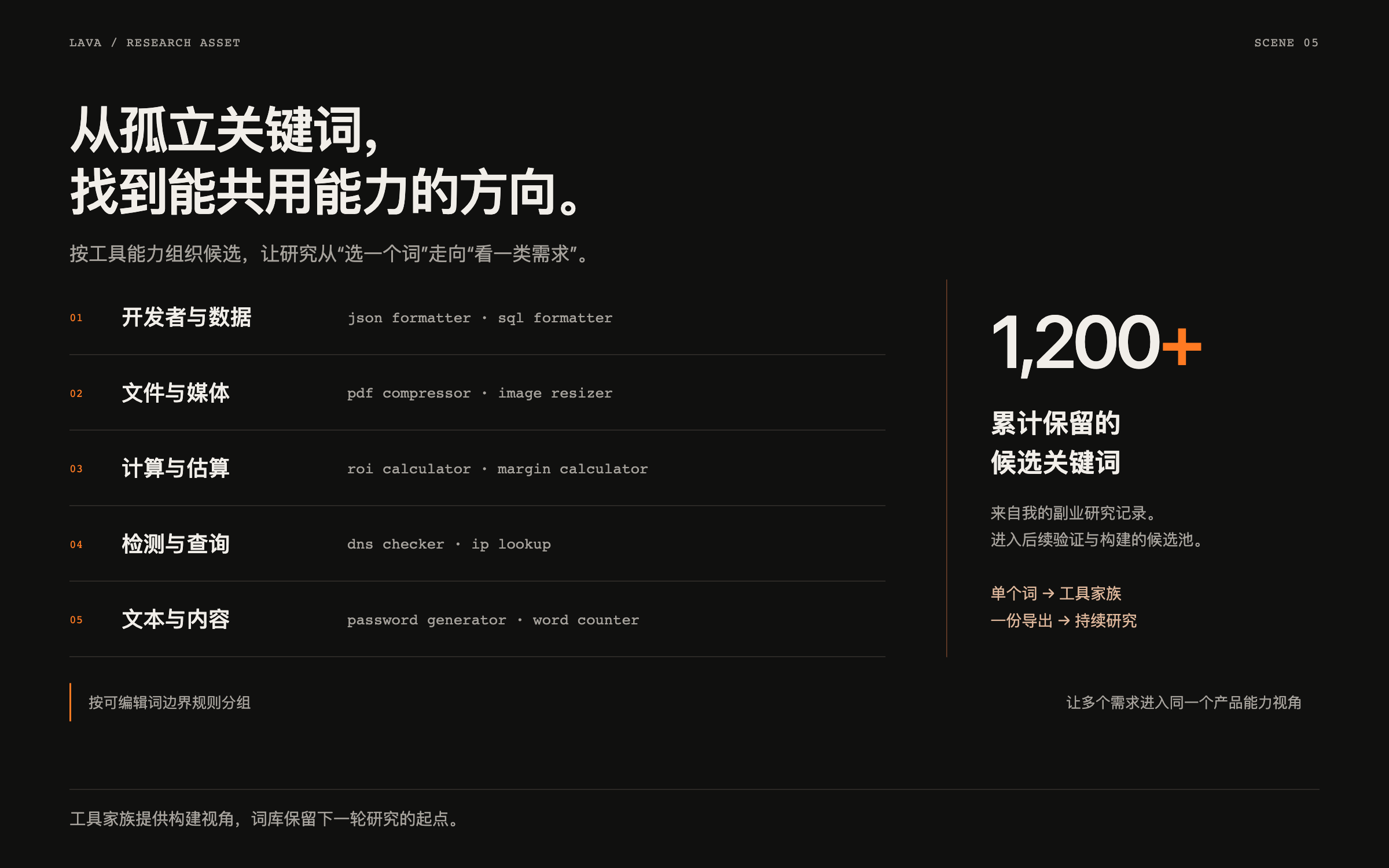
Editable grouping rules organize candidates into developer and data tools, file and media tools, calculators, and other capability families. The purpose is to compare related needs from a building perspective.
Formatting and validation may belong to one data-tool family; compression and conversion can inform a file-tool direction. These groups provide an understandable research path rather than a promise of market demand.
My part
I independently completed the project, translating my own research workflow into import sessions, configurable cleaning rules, candidate states, a persistent library, capability groups, and structured AI business analysis.
In my own use, the workflow accumulated more than 1,200 candidate keywords for further investigation. They form a research queue that helps allocate validation and development time.
Candidates and AI recommendations are starting points for validation. Visuals combine original interfaces and explanatory reconstructions using representative data; displayed SEO metrics and model evaluations are illustrative.