The tasks in bid preparation
Find the opportunity, then understand whether the company can participate.
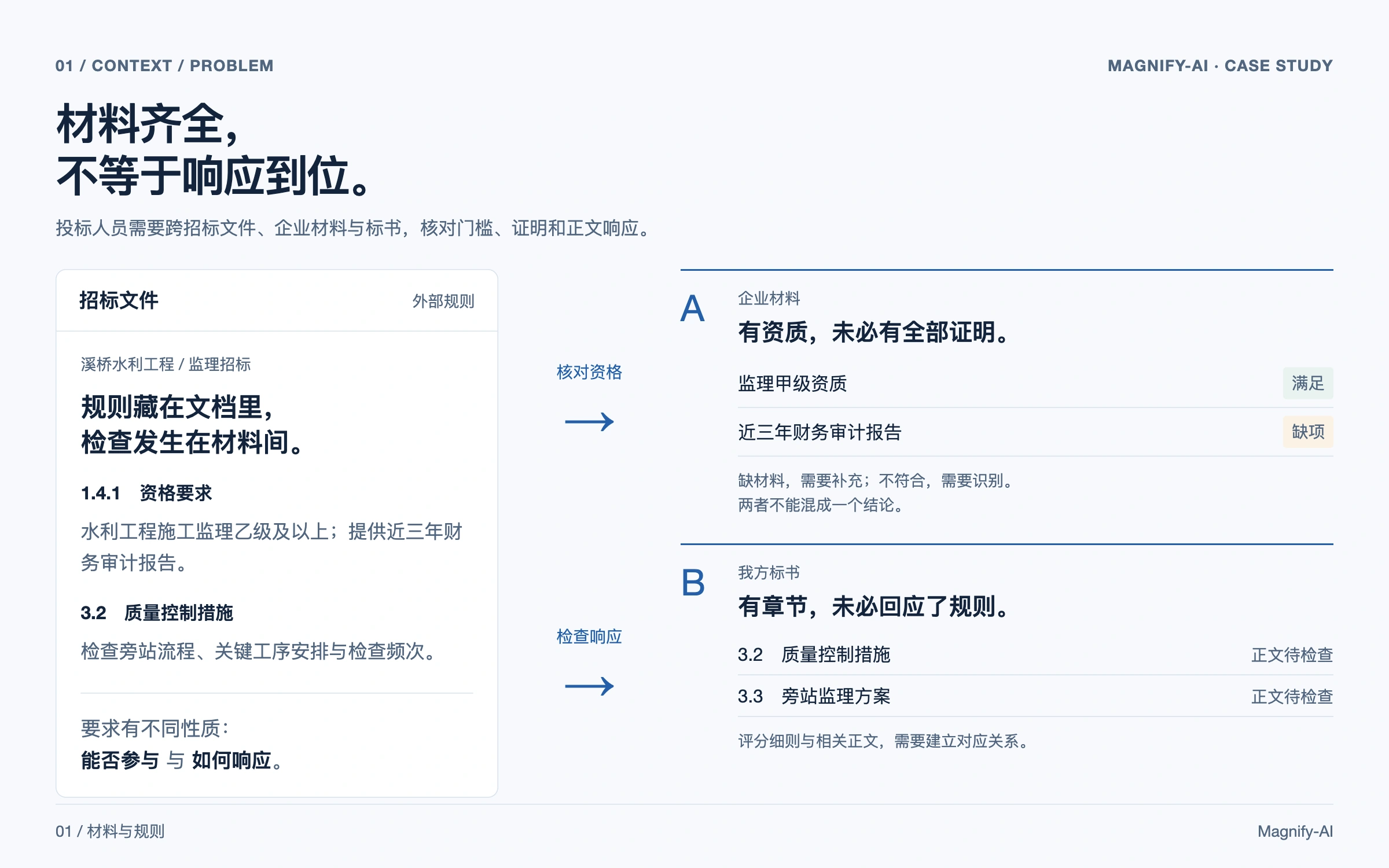
An engineering or supervision bid often begins with an online notice. The team must find relevant projects, read the notice and tender document, understand eligibility and scoring criteria, and compare those requirements with the company’s qualifications and materials before deciding whether to invest further.
The process crosses several sources and kinds of document. A notice identifies the opportunity; the tender sets the rules; company materials describe eligibility; the proposal explains how the project will be delivered. Gathering the files still leaves the work of connecting them item by item.
Magnify-AI puts repetitive collection and document analysis into automated processing paths, leaving the team to examine specific questions: which opportunities fit, which evidence needs supplementing, and which scoring requirements the proposal has yet to address.
Collecting notices and project leads
Collection opens the opportunity pipeline; analysis explains the opportunity.
The project includes notice collection for public-resource trading, government procurement and industry procurement sites. Each site has its own page structure, so collection logic is organized by source and brings scattered information into project leads.
Collection answers which projects deserve a closer look. AI analysis then examines what those projects require. Linking the two in the product lets the team continue from an opportunity into rules, qualifications and materials.
I organized opportunity information, tender analysis, company qualifications and proposals in a continuous working context. Collected information has a place for further processing, and analysis remains tied to a particular project.
Tender rules and company qualifications
Eligibility, technical conditions and scoring criteria need distinct representations.
A tender contains project descriptions, eligibility conditions, technical requirements and scoring rules together. A summary alone leaves the team searching again for individual requirements and determining which apply to the company.
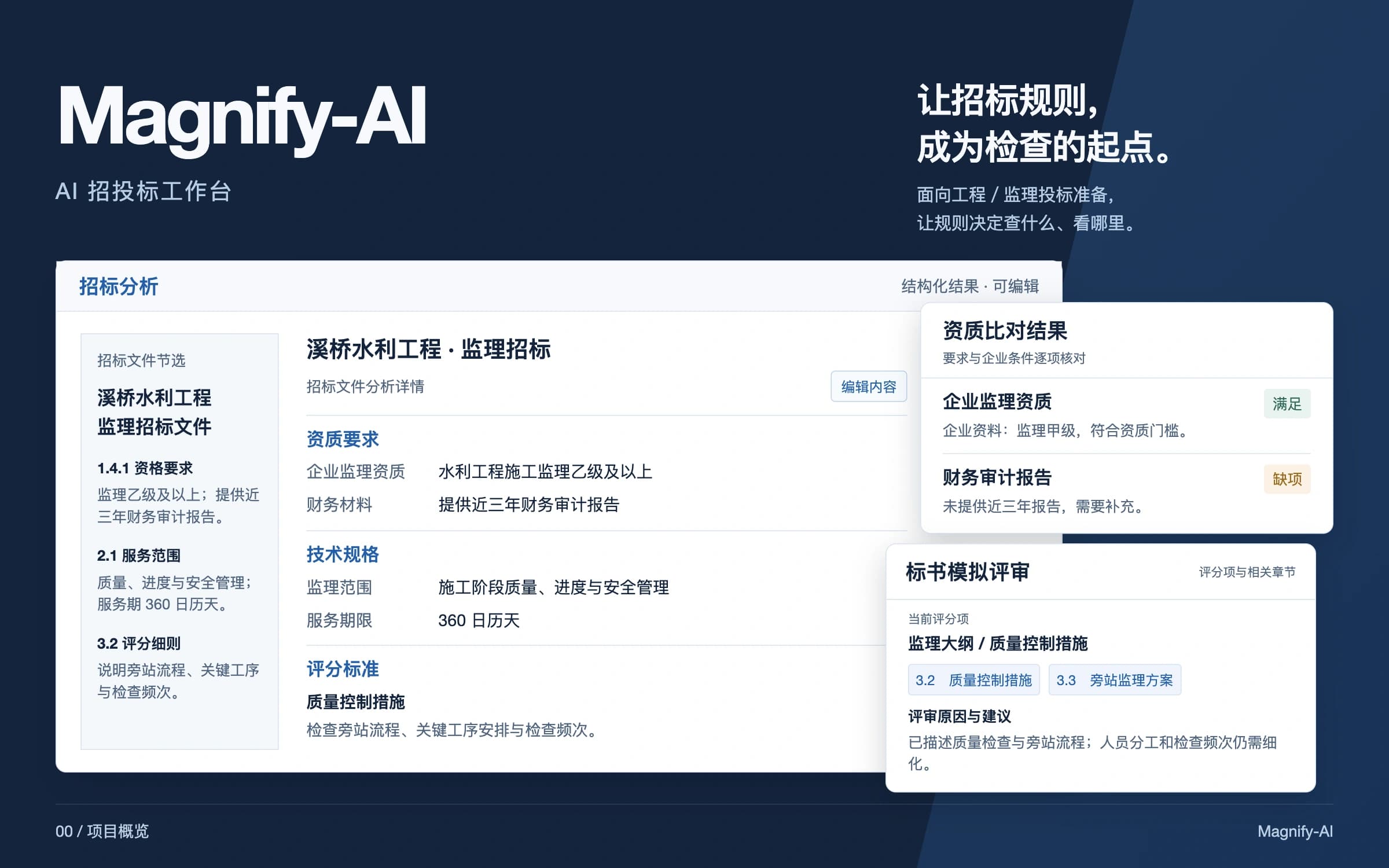
I organized analysis into qualification requirements, technical specifications and scoring criteria. Each group supports a different action: eligibility feeds company checks, while technical and scoring requirements guide proposal preparation and simulated review. Structure creates comparable objects across documents.
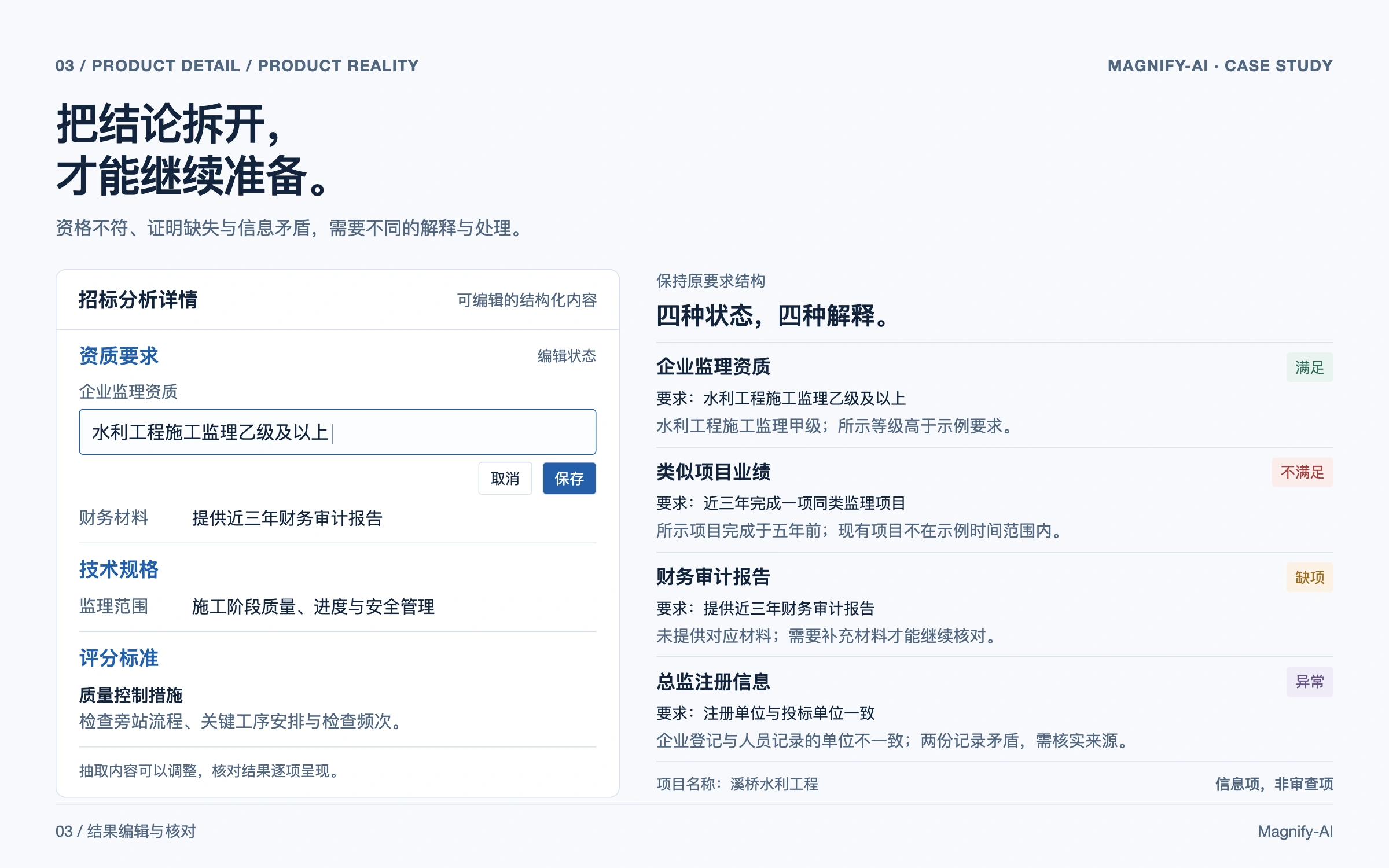
Extracted content remains editable. Business users can correct and supplement it before proceeding. AI organizes dense material into readable information; the workspace lets that information participate in the preparation process.
Matches and missing evidence
A combined assessment needs a path back to individual conditions.
The system compares tender requirements with existing company qualifications while preserving the requirement structure. It distinguishes satisfied, unmet, missing and inconsistent items and retains explanations so the team can understand suitable opportunities separately from those needing more material.
Those states imply different actions. An unmet item indicates a difference between the company and the requirement; a missing item indicates absent evidence; an inconsistency identifies conflicting information. A single match score would hide what needs to happen next.
Analysis also provides potential scores and a combined conclusion as references for further assessment. Scores and item-level reasons share one reading path: the team gets an overview and can return to eligibility, potential scoring points and missing evidence. Scores support comparison; individual requirements guide preparation.
Checking chapters against scoring criteria
An eligible company still needs a proposal that addresses the rules.
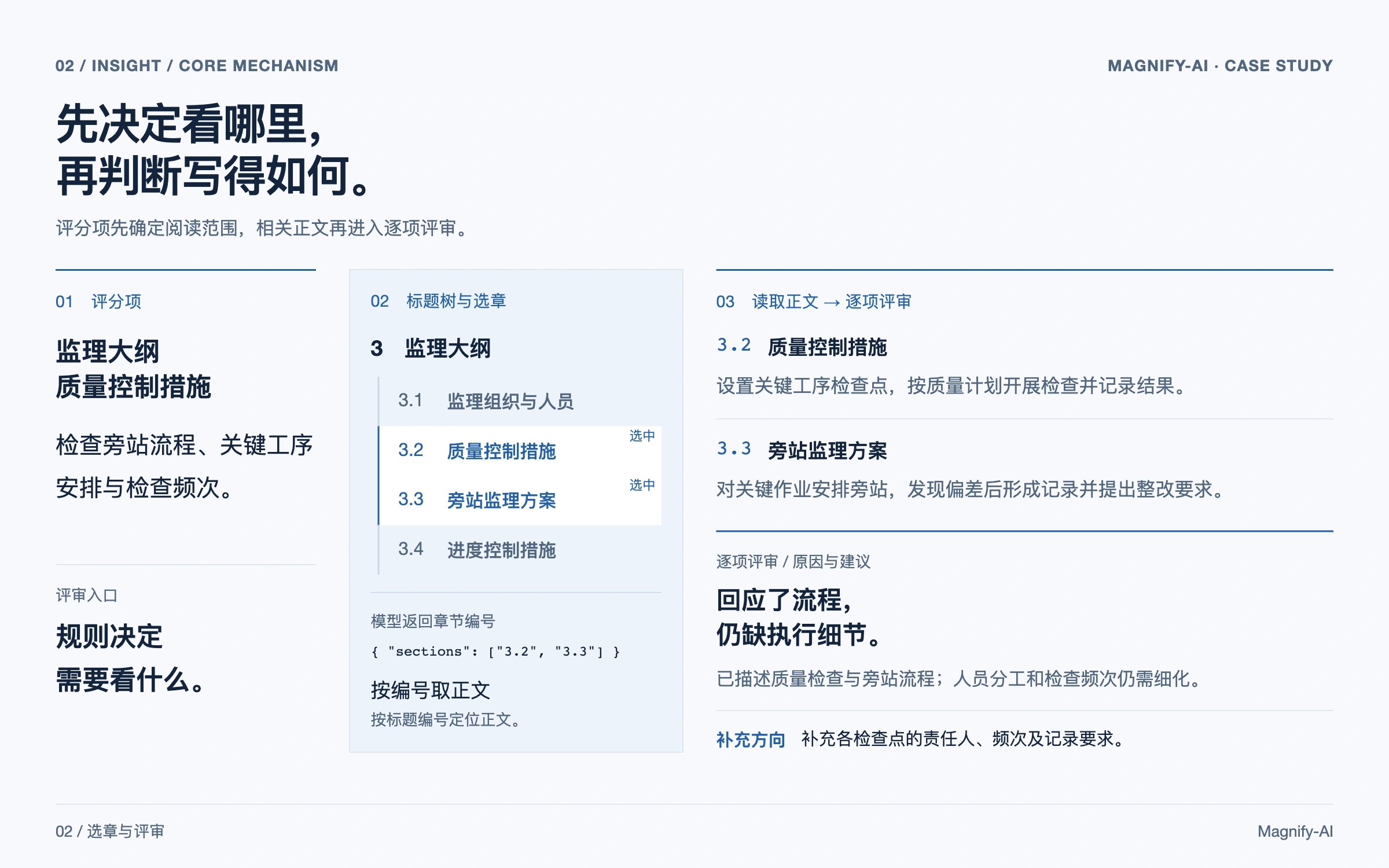
A chapter titled “Quality control” does not necessarily explain inspection methods or frequency. Simulated review must begin with a particular criterion and find the content that actually responds to it.
Magnify-AI first gives the scoring item and proposal title tree to the model to select relevant chapter identifiers. The system retrieves those chapters, generates reasons and suggestions around the criterion, and assembles a report. Separating selection from review keeps the reading scope aligned with the judgment.
This moves analysis from a general opinion on a whole document to reading specific content against a specific rule. The team can use criterion-level reasons and suggestions to revise the relevant chapters.
Collection, document processing, and AI analysis
Each result needs project ownership and a processing state.
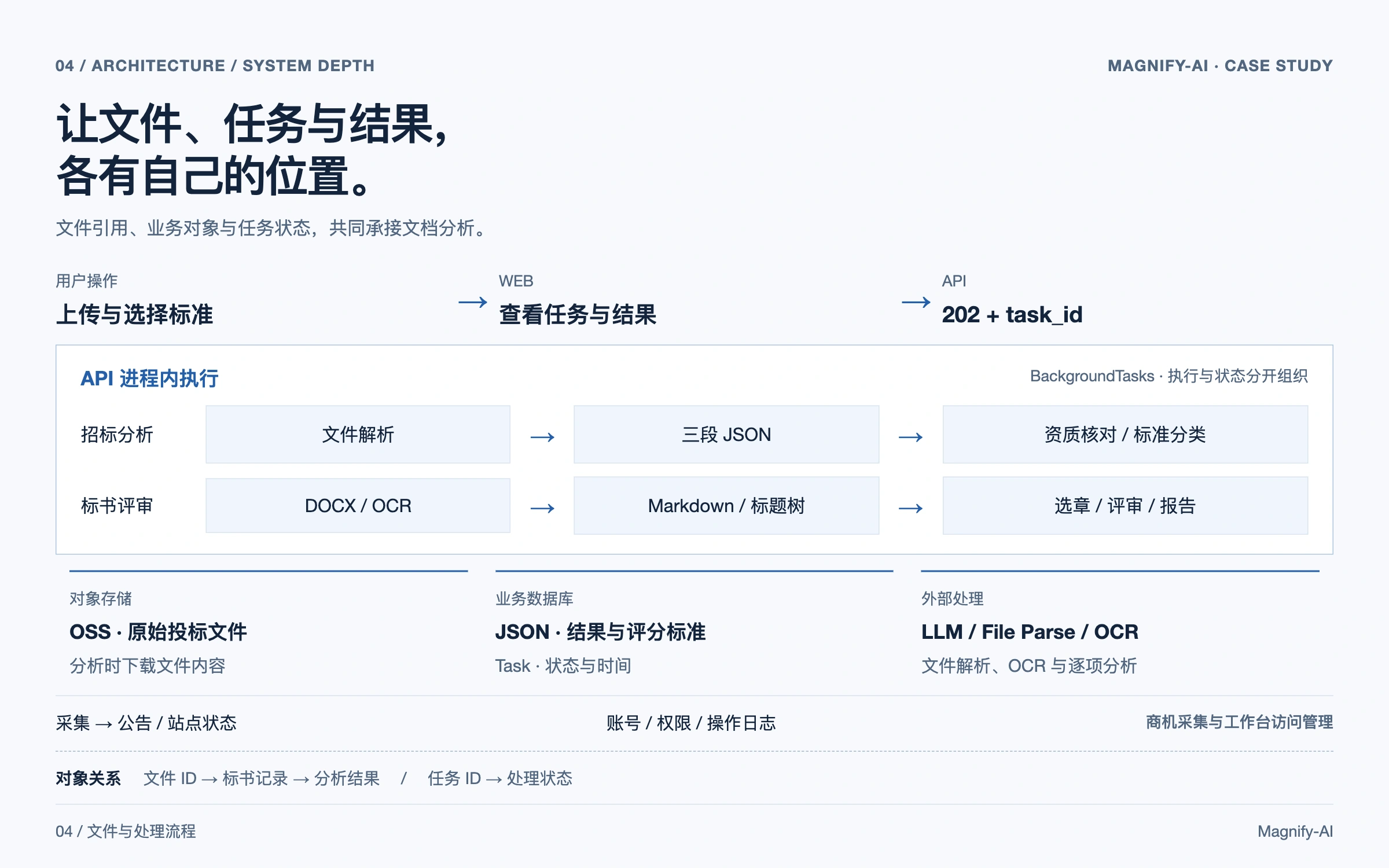
Bid analysis involves original files, structured requirements, company information, task progress and reports. They need separate representations connected by project and file references, or model output can become text detached from its business context.
I built the frontend and backend and connected uploads, parsing, OCR and model processing to the analysis path. Object storage holds original files; business objects hold requirements and reports; task identifiers and state describe progress. The workspace brings requests, progress and results back to the relevant material.
Automation needs usable outputs. Parsing handles input, models interpret content, and structured objects and state management return that analysis to the workspace.
Three design choices
Each automated step needs a clear business object.
Qualification checks and proposal review are separate: one examines company eligibility, the other the proposal’s response to scoring criteria. They share tender requirements but examine different materials, keeping one aggregate score from carrying every judgment.
Scoring criteria also determine the reading scope. Chapter selection precedes content review, organizing model analysis under specific rules and giving the report a clear subject.
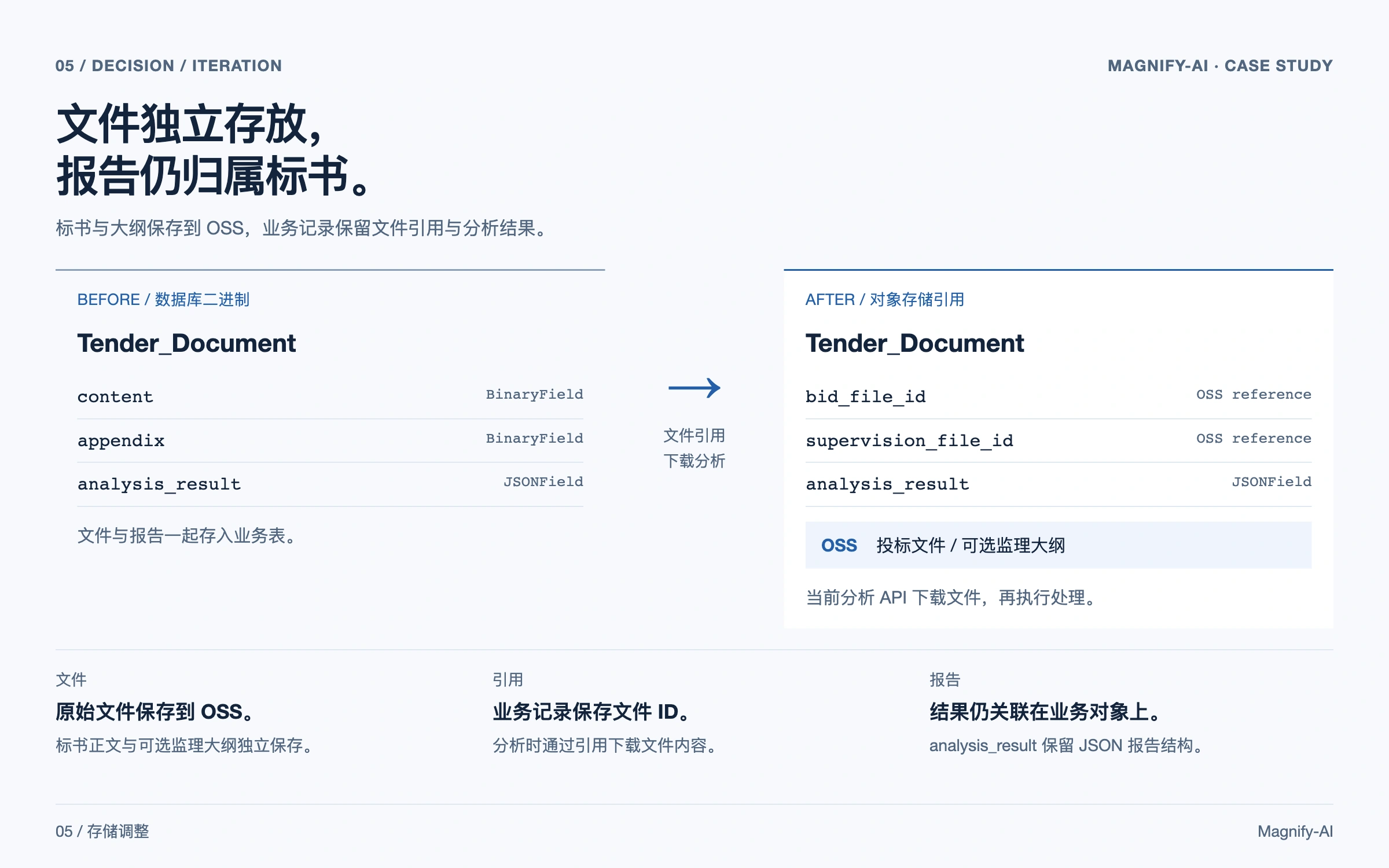
Files and business results retain different ownership. Proposal content and the optional supervision outline share a title index. File storage moves from database binaries to object references, while reports remain attached to the proposal. The processing path can retrieve the required material through those references.
My part
Independent ownership of product structure, frontend, backend, collection and AI document analysis.
I framed the project around the wider preparation process: discovering opportunities online, interpreting tender rules, comparing company qualifications and examining proposal responses. That framing determined the workspace’s business objects and where each automated result should go.
At the product level, I connected notices, requirements, company information and proposals into a continuous path for assessment and preparation. States and results needed to correspond to useful business actions rather than simply displaying model output.
At the AI-processing level, I implemented requirement extraction, item-level qualification comparison, potential-score analysis and simulated proposal review. Structured requirements, four qualification states, and criterion-led chapter selection give each model call a concrete purpose.
At the engineering level, I built the web application and API, notice-collection components, parsing and OCR integration, and the organization of file references, results and task states. The same product logic connects how material enters the system, how progress is expressed and where reports are saved.
My guiding idea was to make AI analysis usable in the next business step. Collection should leave an opportunity to assess, comparison should explain a difference to address, and review should point to relevant chapters.
The resulting workflow
Opportunities have an entry point, requirements have structure and findings have follow-up actions.
Magnify-AI brings notice collection, requirement analysis, qualification checks, score references and simulated proposal review into one workspace. Teams can move from a project lead into its rules, then prepare material around condition differences and review suggestions.
The product model is rule-led bid preparation: repetitive information processing enters automated paths, business judgment stays grounded in specific conditions, and findings return to the project and proposal.
About the presentation
This project supports bid preparation. Simulated review is not a formal tender evaluation or a prediction of award outcomes.
Visuals are reconstructed from the original implementation using synthetic example data.