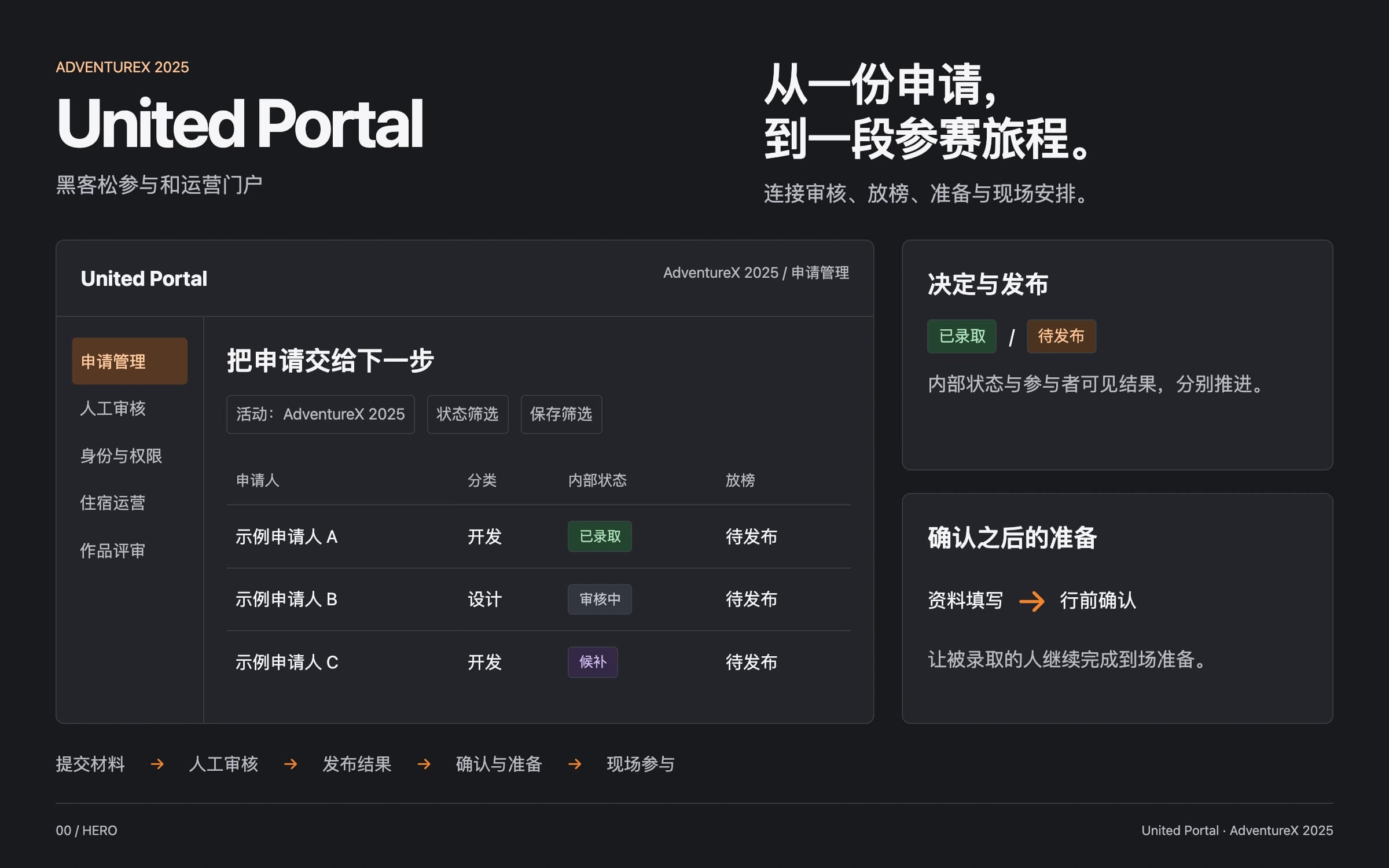
What follows an application
Participants keep moving; each handoff brings a different responsibility for organizers.
AdventureX 2025 took place in Hangzhou on July 23–27. Post-event reporting described more than 800 participants, five days and 120 hours of collaboration, and over 200 technology ideas.
I was deeply involved in organizing the onsite event and contributed to the internal system supporting applications, review, preparation, and operations. The work began before participants arrived and continued through the final project showcase.
Organizers need to evaluate applicants, release results, confirm attendance, collect information, and arrange accommodation and submissions. A single registration or acceptance state cannot describe the whole journey.
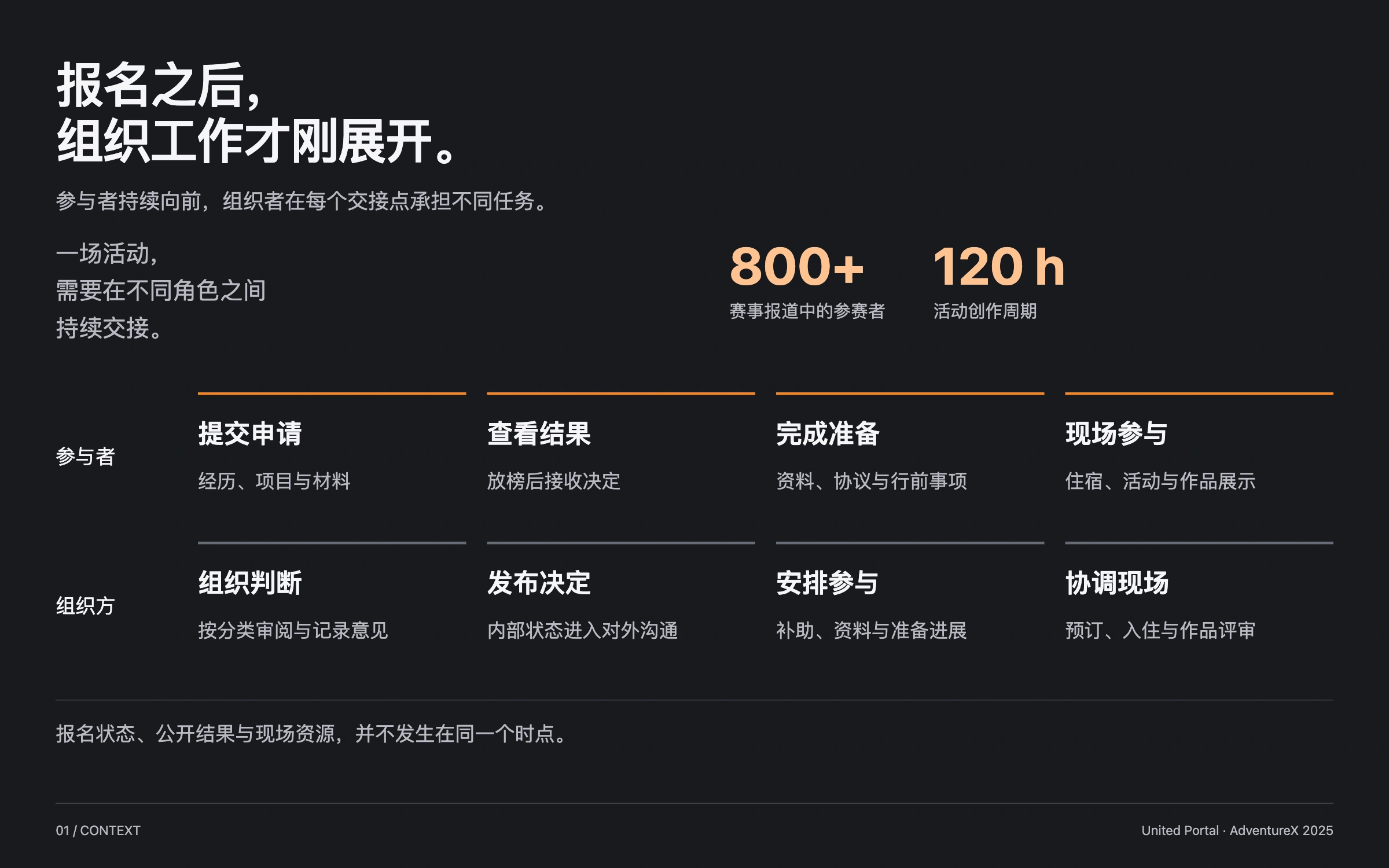
Reviewers and decisions
Categories, materials, reasons, and multiple reviewers contribute to the review process.
Reviewers record opinions, organizers manage decisions and result release, participants confirm and prepare, and onsite staff handle check-in. A shared participant identity connects the work while each role retains its own operating scope.
Applications are routed to suitable reviewers by categories such as development and design. Previously reviewed applications are excluded from that reviewer’s next assignment. Materials, tags, reasons, and acceptance, rejection, uncertainty, or reassignment actions sit in one workspace; opinions feed the application state according to team rules.
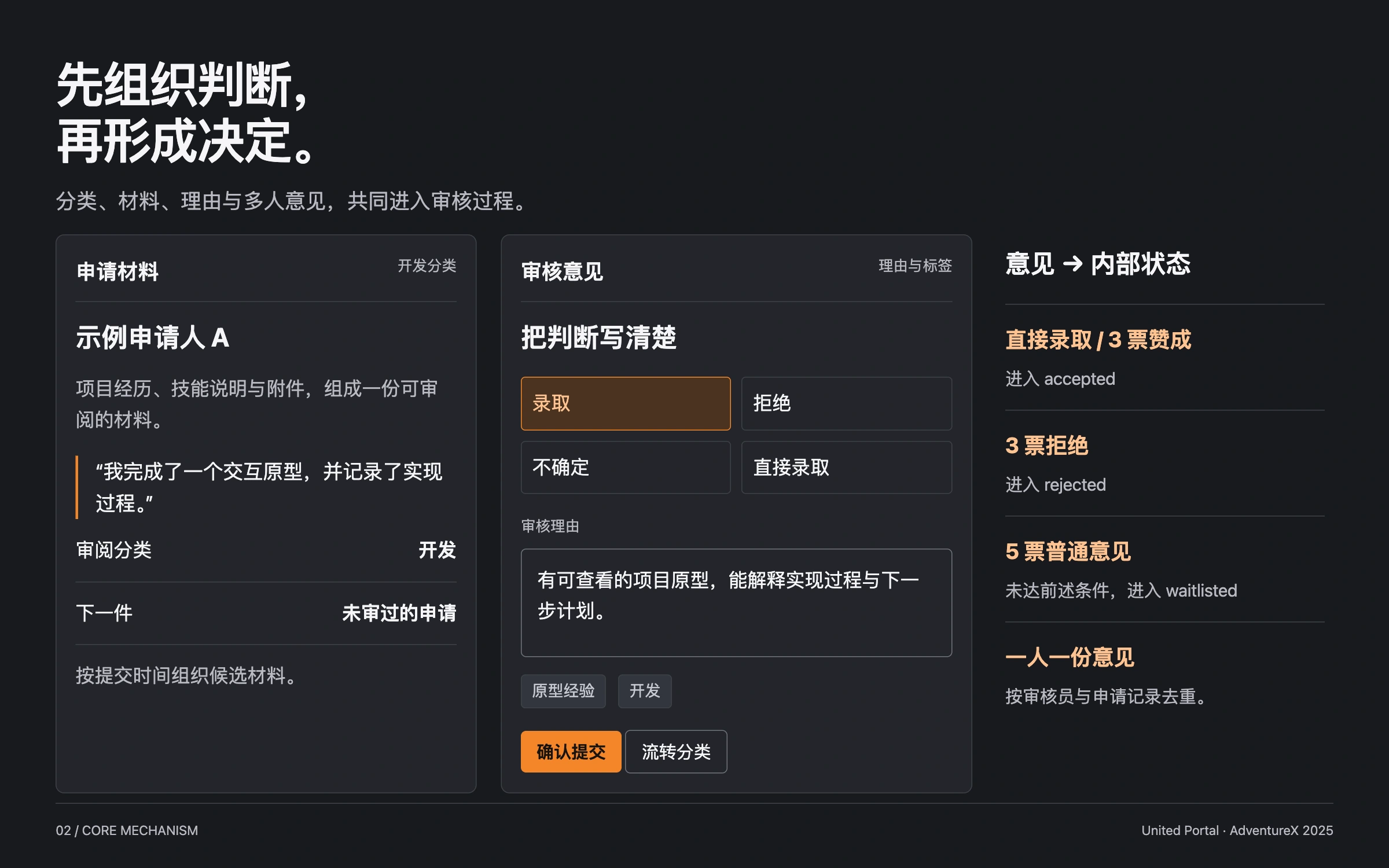
Preparing the result release
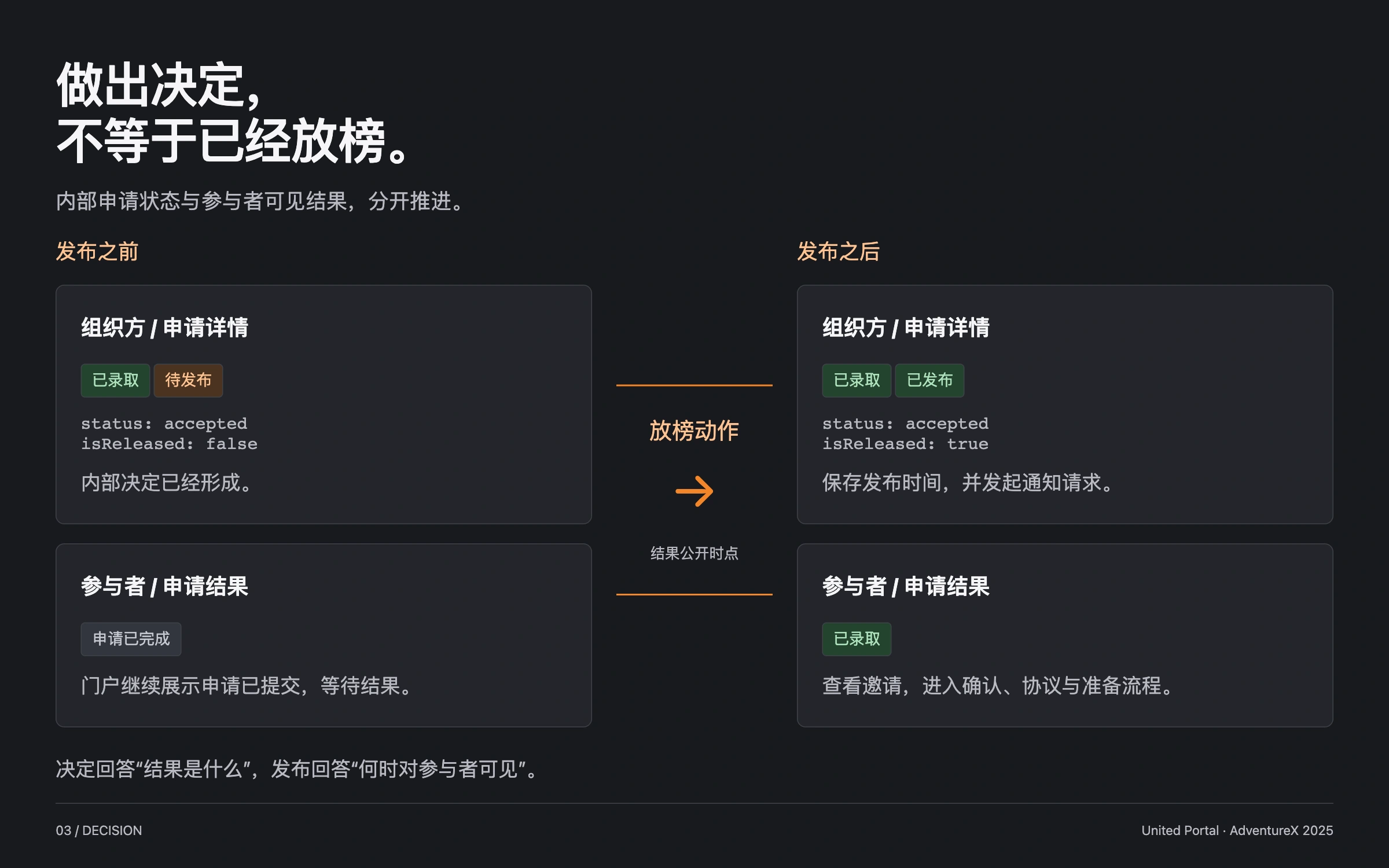
Internal application status and participant-visible results advance independently.
An application can be accepted internally before organizers publish the result. Until release, the applicant still sees the application as completed. Keeping these moments separate gives the team an explicit point at which an internal judgment becomes external communication.
Pre-event arrangements after acceptance
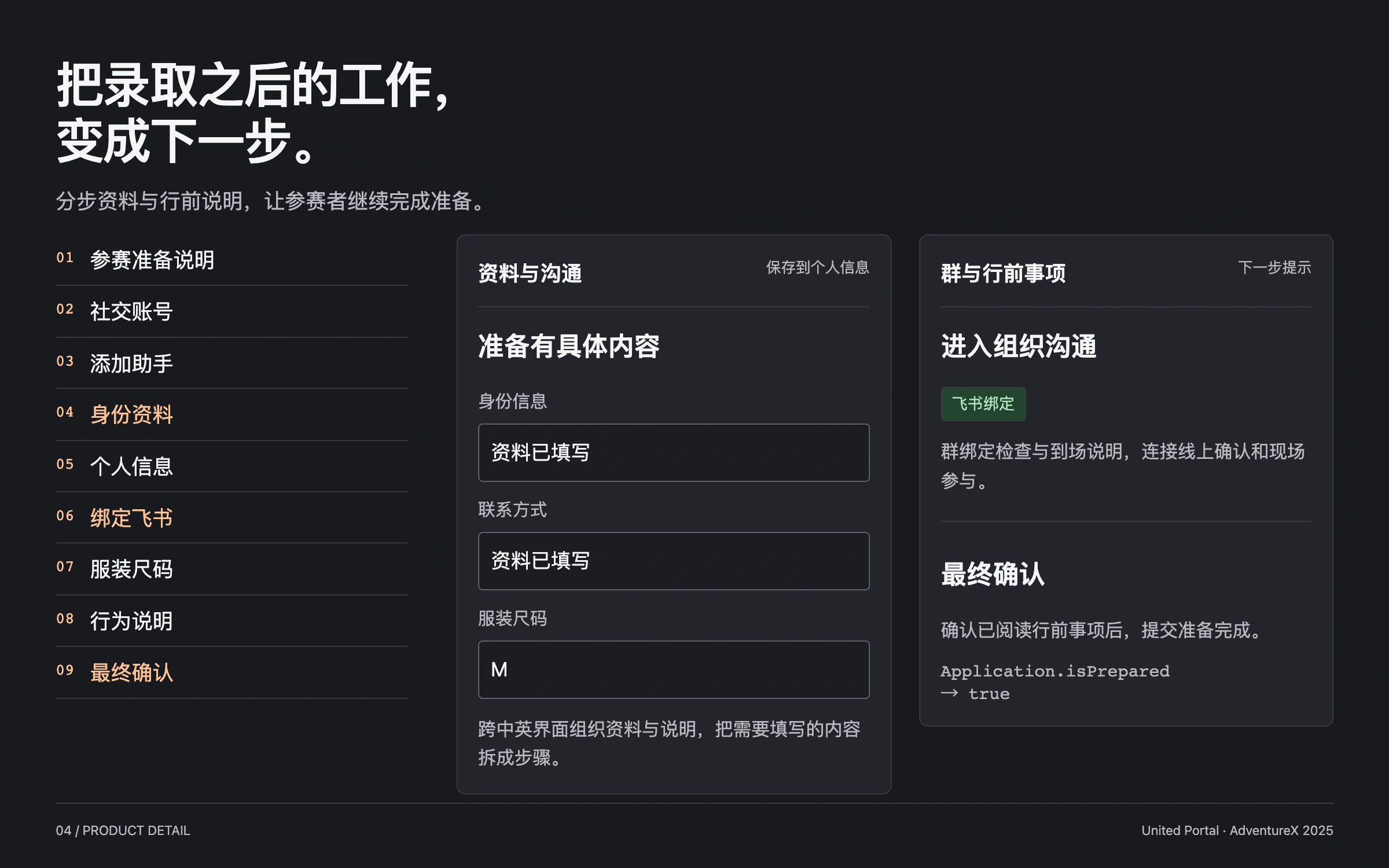
Step-by-step information and arrival guidance support participant preparation.
After accepting an invitation, participants still need to provide information and complete practical arrangements. I implemented a staged preparation flow covering identity, contact details, group binding, clothing, and arrival guidance. Completion updates the application so the portal can continue directing the next action.
Hotels and room assignments
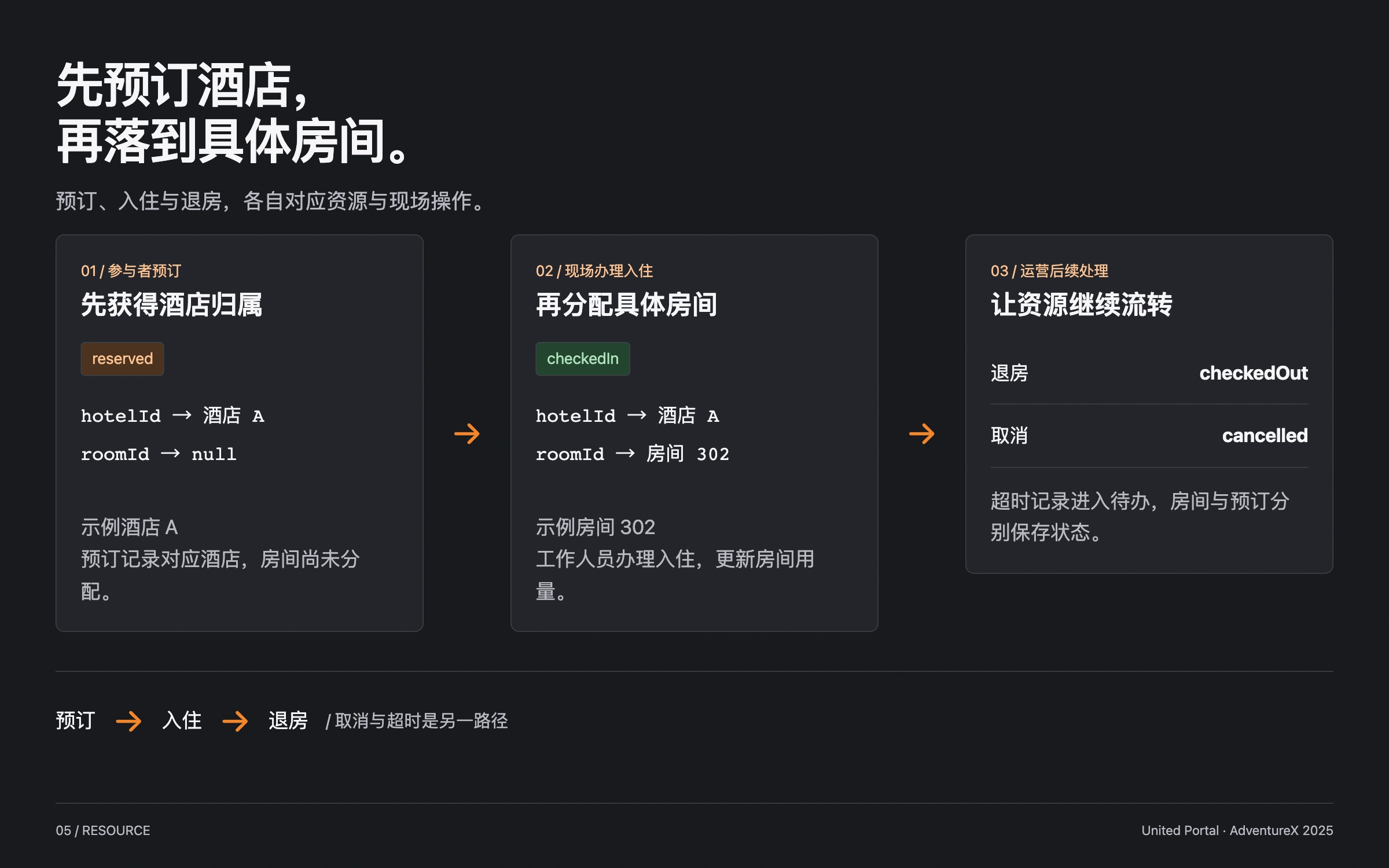
Reservations, check-in, and check-out serve different operational tasks.
Accommodation separates hotel-level reservation from onsite room assignment. Participants first receive a reservation associated with a hotel; onsite staff assign a specific room at check-in and update occupancy. Check-out and overdue records appear in the operations view. The accommodation commitment and the physical room assignment remain distinct tasks.
Permissions for each role
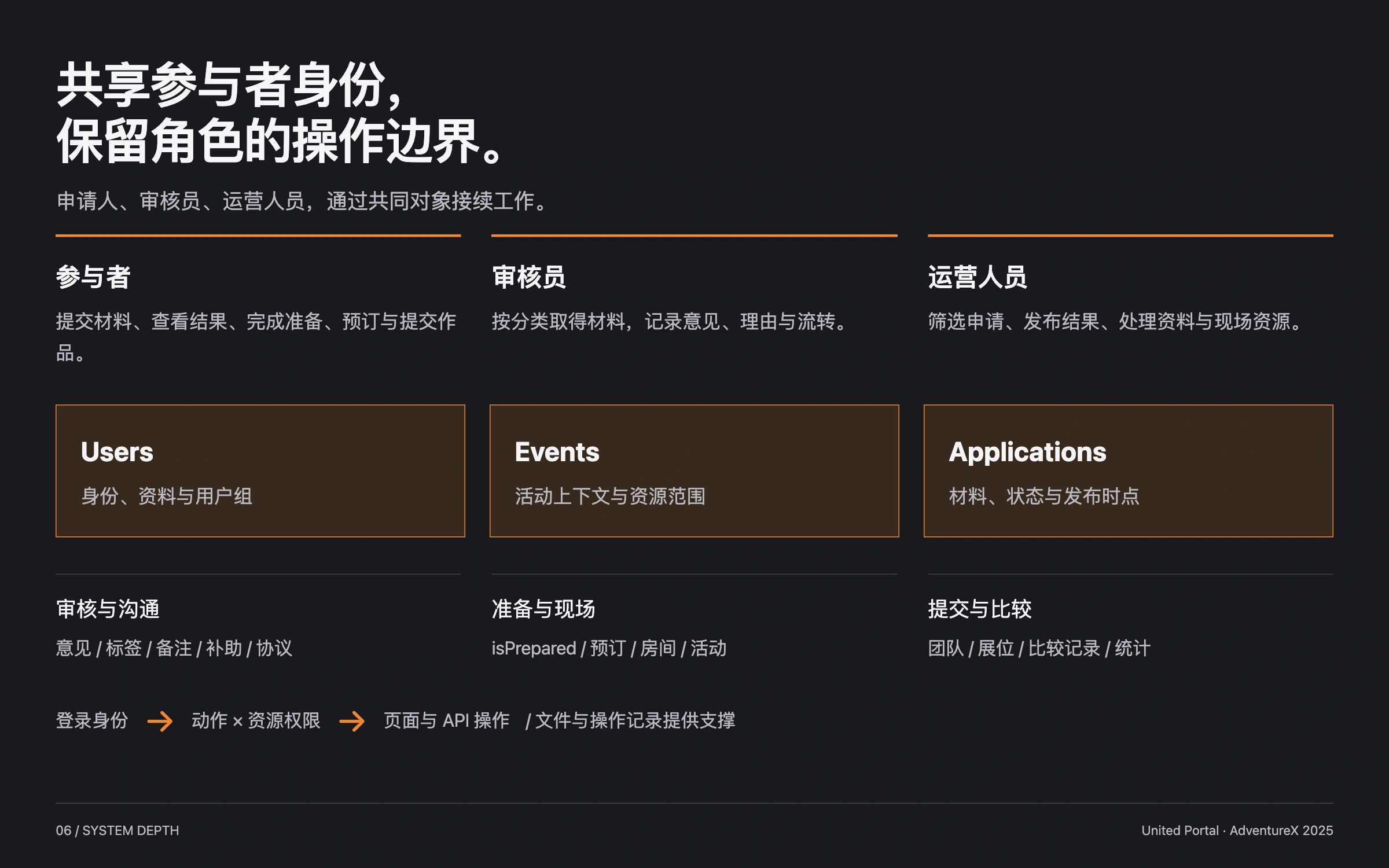
Applicants, reviewers, and operators continue work around common records.
Participants submit and prepare in the portal, reviewers examine materials, and administrators manage applications and resources. Common user, event, and application records connect the modules. Server-side permissions identify actions and resources; tags, notes, and operation records help staff locate the relevant issue.
On-site judging records
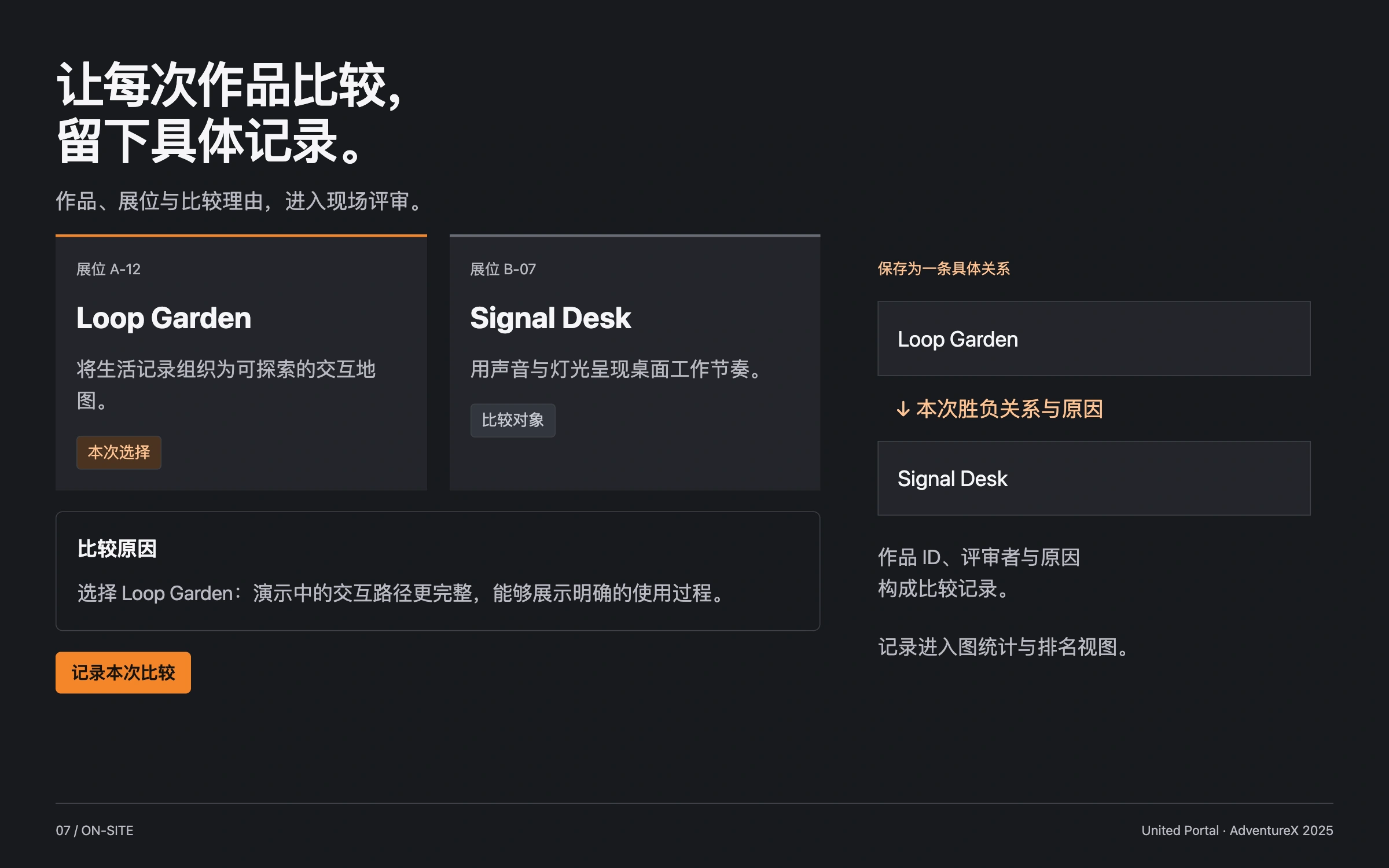
Projects, booths, and comparison reasons become part of onsite evaluation.
When creation ends, projects move into submission and presentation. I contributed to project submission, member confirmation, booth information, and pairwise evaluation. A reviewer selects one of two projects and records a reason; the comparison then feeds graph statistics and ranking views. Each judgment remains a concrete record.
My work in organizing and development
I was deeply involved in organizing AdventureX 2025 onsite and contributed as a core developer within the team. My work included application forms and validation, review and application management tools, filtering and queries, participant preparation, accommodation operations, project submission, and onsite comparison evaluation.
The contribution crossed participant-facing and internal operations interfaces, connecting practical event tasks with pages, interfaces, and business states. Authentication and permission foundations, review rules, and other platform capabilities were built collectively by the team.
During and after the event
The portal extended registration into the later stages of the event: materials entered review, internal decisions became published results, and attendance confirmation led into preparation and onsite arrangements.
Working on both event organizing and software connected system behavior with the real participant journey. This case focuses on my organizing and development contributions. Event-scale figures come from 2025 post-event reporting by Business Management Review, republished by Sina Finance. Interfaces and workflows are reconstructed from the project implementation using synthetic example data.