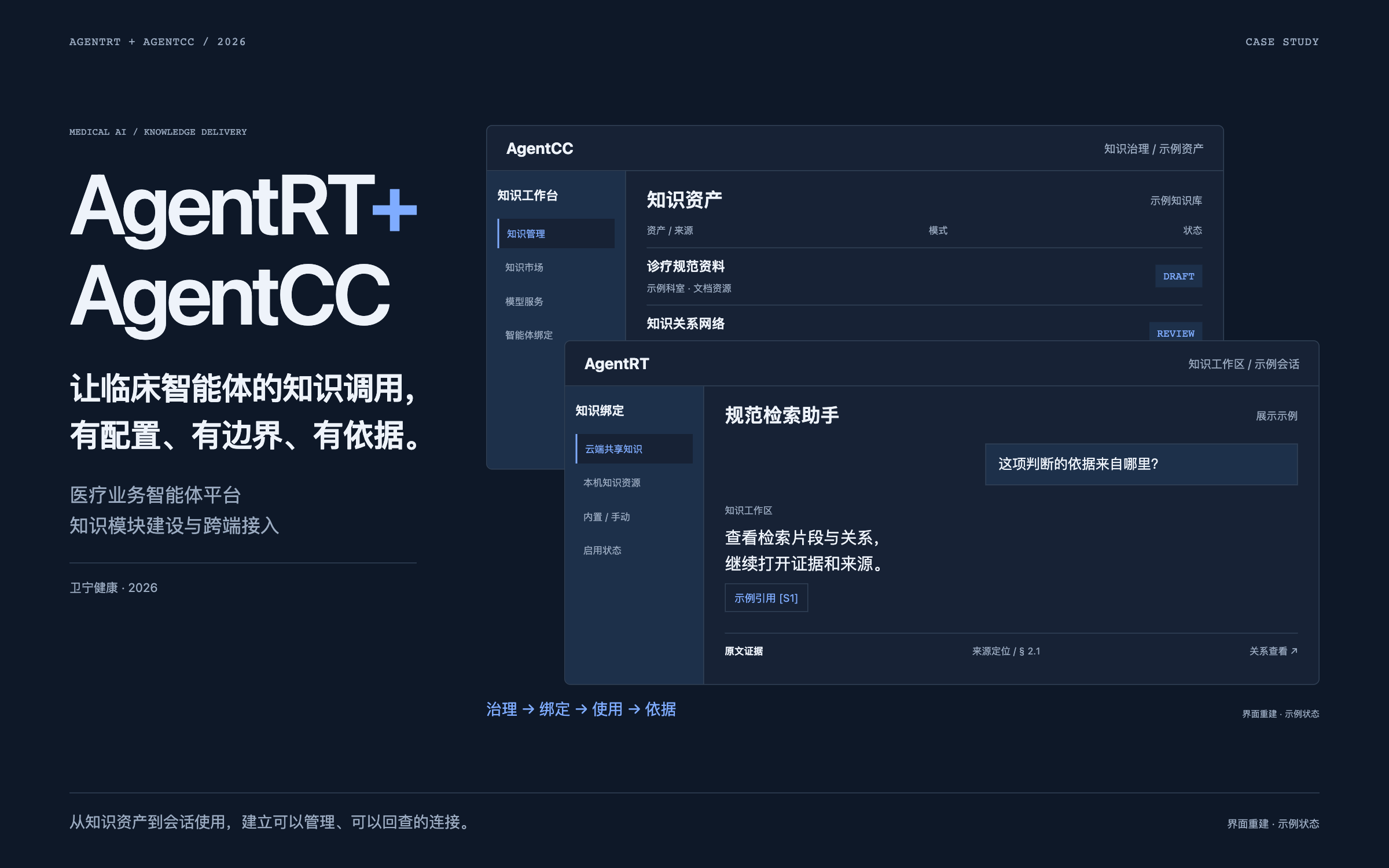
Clinical guidance and its sources
Retrieving a passage is one step in a longer knowledge workflow.
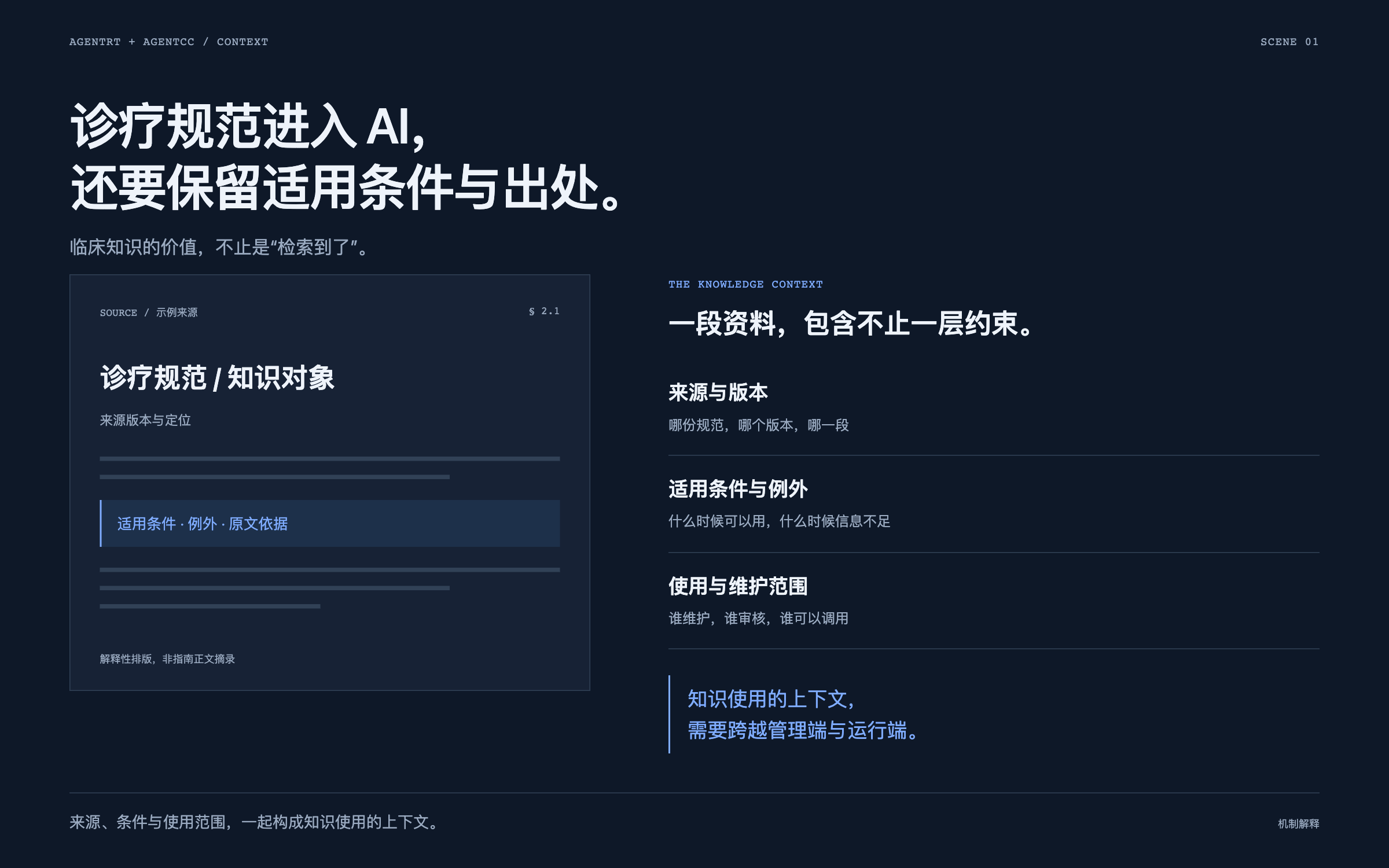
Clinical material includes conditions, exceptions, versions, and evidence. Uploading it does not establish which knowledge may be used, which agent it belongs to, or how a user returns to the source. My work focused on these handoffs between governed knowledge assets and their use in conversations.
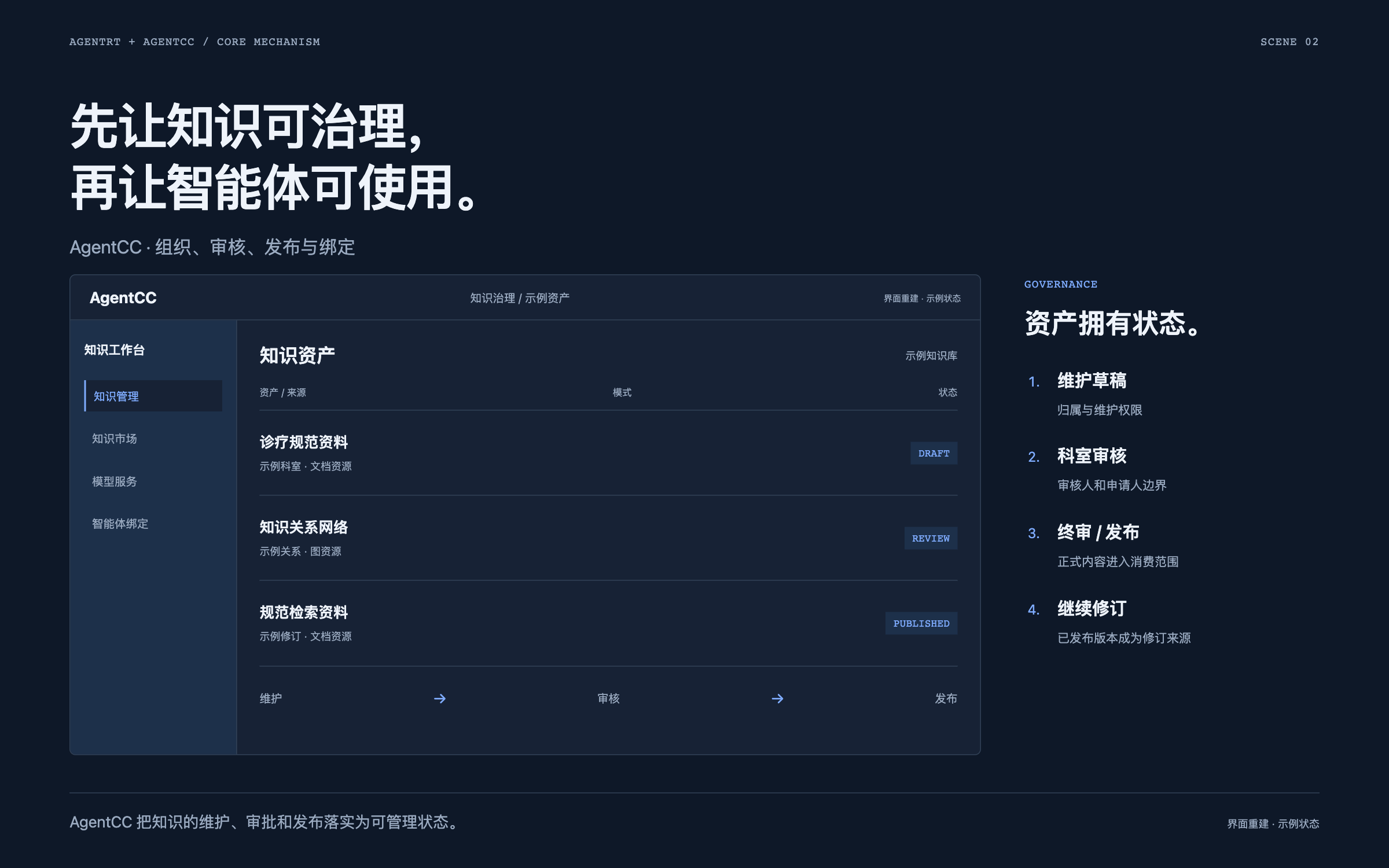
Knowledge governance in the admin client
AgentCC · Organization, review, publication, and binding.
I built knowledge-management and marketplace capabilities in AgentCC, connecting ownership, review, publication, graph versions, and agent bindings through explicit states. Publication and revision are separate, and management actions have permission and approval boundaries. Knowledge becomes a managed resource with a lifecycle.
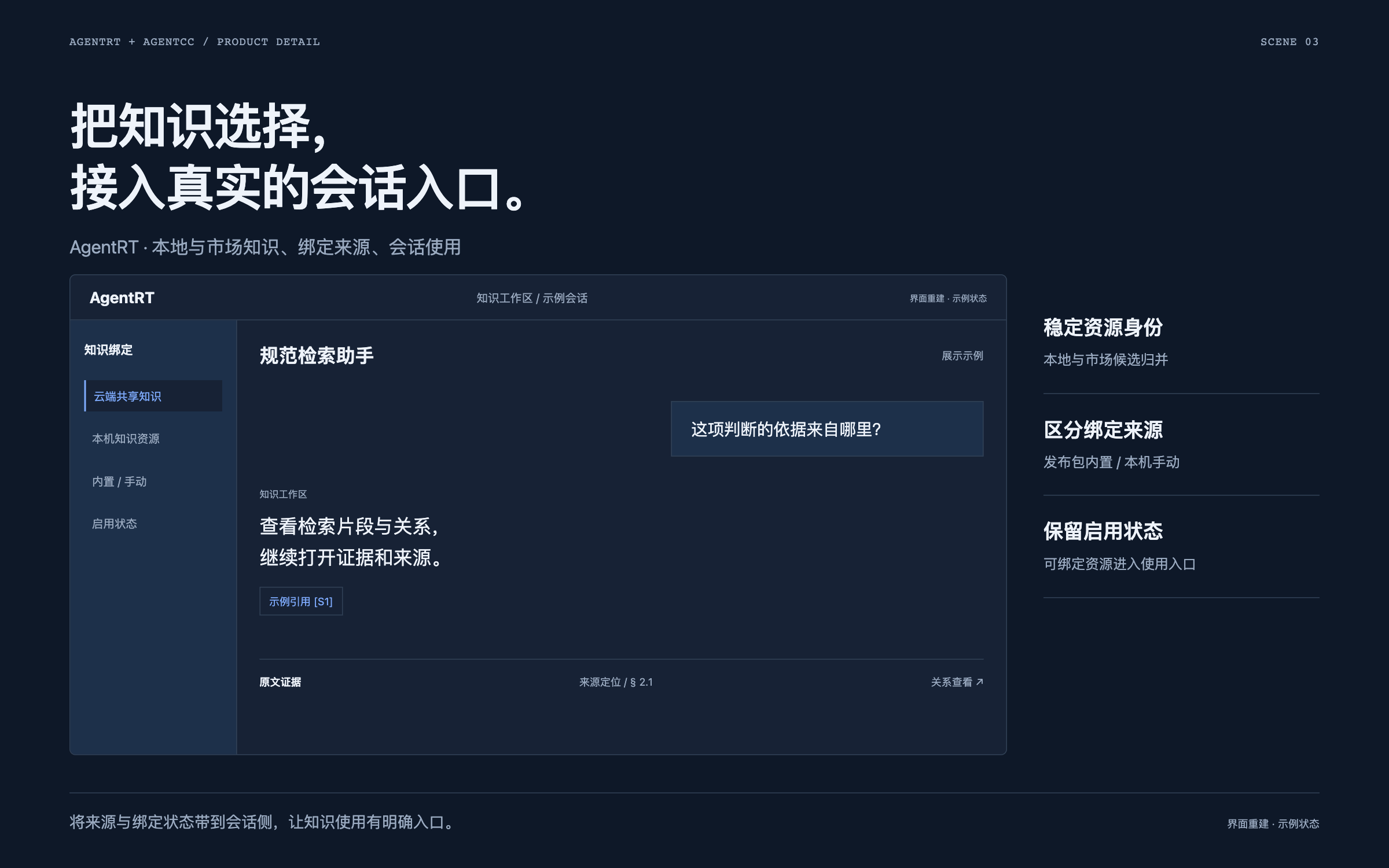
Choosing knowledge for a conversation
AgentRT · Local and marketplace knowledge, binding sources, and conversations.
On the runtime side, I worked on knowledge libraries, marketplace consumption, and RAG/KAG integration. The binding panel distinguishes local and cloud sources as well as built-in and manually configured resources, retaining stable identity and enabled status. Before knowledge reaches the model, it becomes a resource the agent can explicitly select and use.
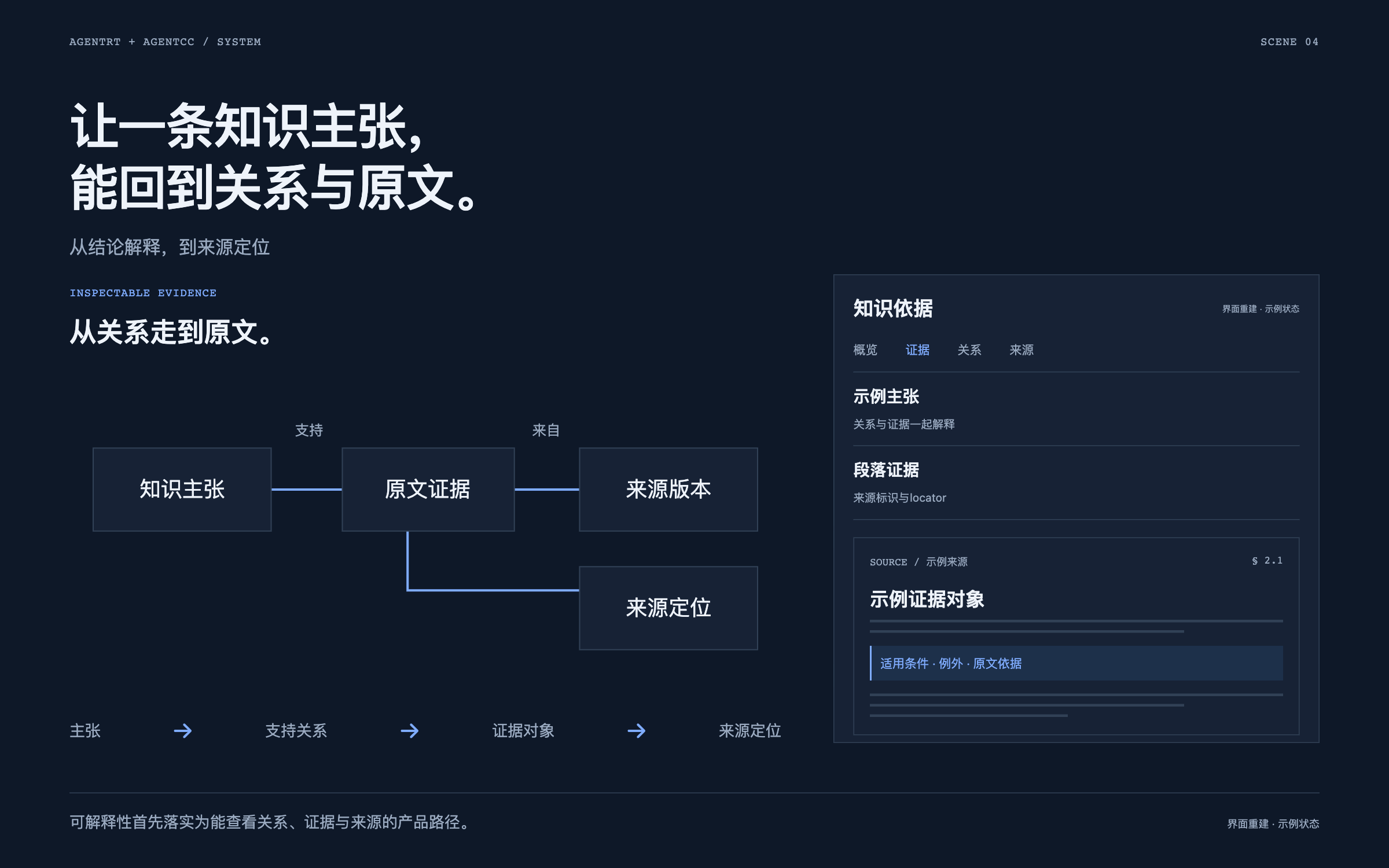
Answers, relationships, and source material
From explaining a result to locating its source.
A knowledge graph needs understandable interactions. I advanced relationship inspection, evidence drawers, and document records so nodes connect knowledge claims with evidence objects and source locations. The runtime also presents graph-retrieval traces. This creates a practical path for checking supporting material; the graph itself does not establish medical correctness.
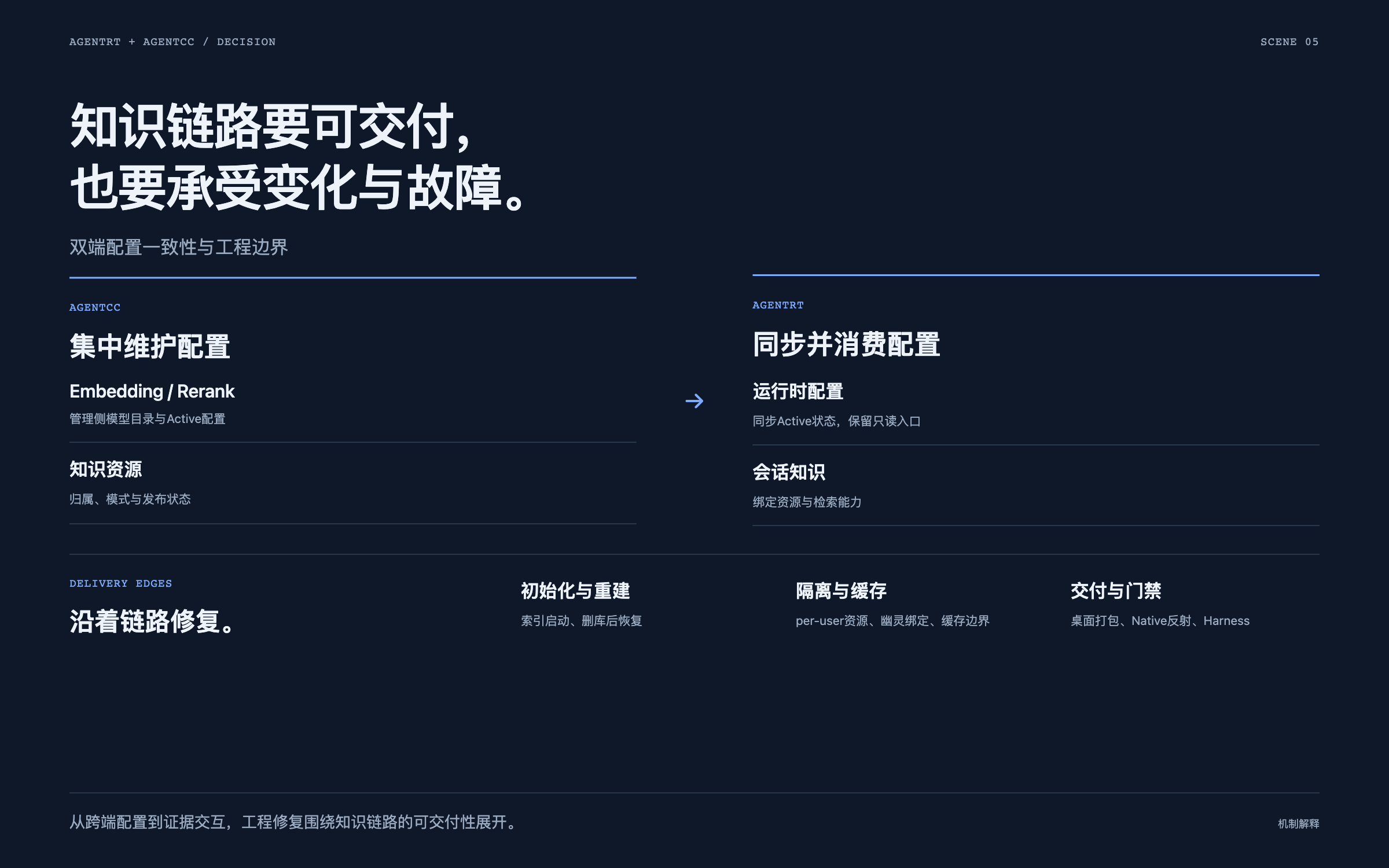
Configuration changes and error handling
Cross-client consistency and engineering boundaries.
After connecting the feature path, I continued work on model-configuration synchronization, index initialization, caching, isolation, and desktop delivery, and implemented part of the engineering conventions through Harness gates. The work follows one knowledge chain: management defines configuration, runtime consumes it, and corresponding checks verify the repaired behavior.
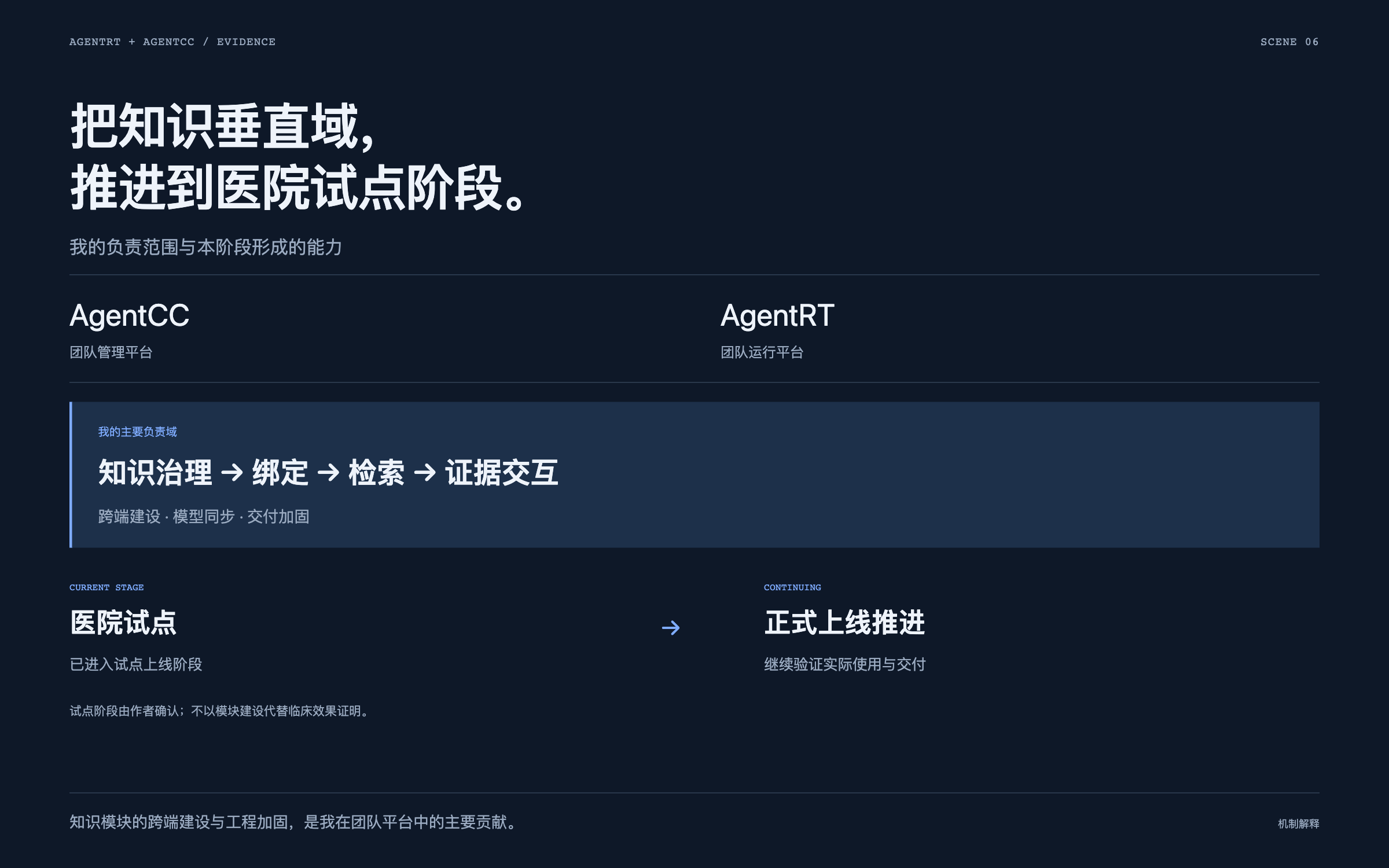
Hospital pilot progress
My scope and the capabilities built in this phase.
I focused on the knowledge module across both clients and contributed additional platform repairs and delivery hardening. AgentRT and AgentCC are team-built agent platforms; my contribution spans knowledge governance, binding, retrieval, and evidence interactions. The platform has entered hospital pilots while formal rollout and further validation continue.
My part
My main responsibility was the knowledge module across both clients: governance, marketplace, and publication capabilities in AgentCC, and knowledge integration, RAG/KAG, and evidence interactions in AgentRT. I also contributed configuration synchronization, initialization, isolation, desktop delivery, and engineering gates. The platform was built collaboratively; my scope is the knowledge domain connecting management with runtime.
Visuals use de-identified interfaces and explanatory reconstructions. Example states, citations, and conversations illustrate the workflow. Project stages reflect the author’s current work account; source traceability, content scale, and engineering checks are distinct from clinical validation.