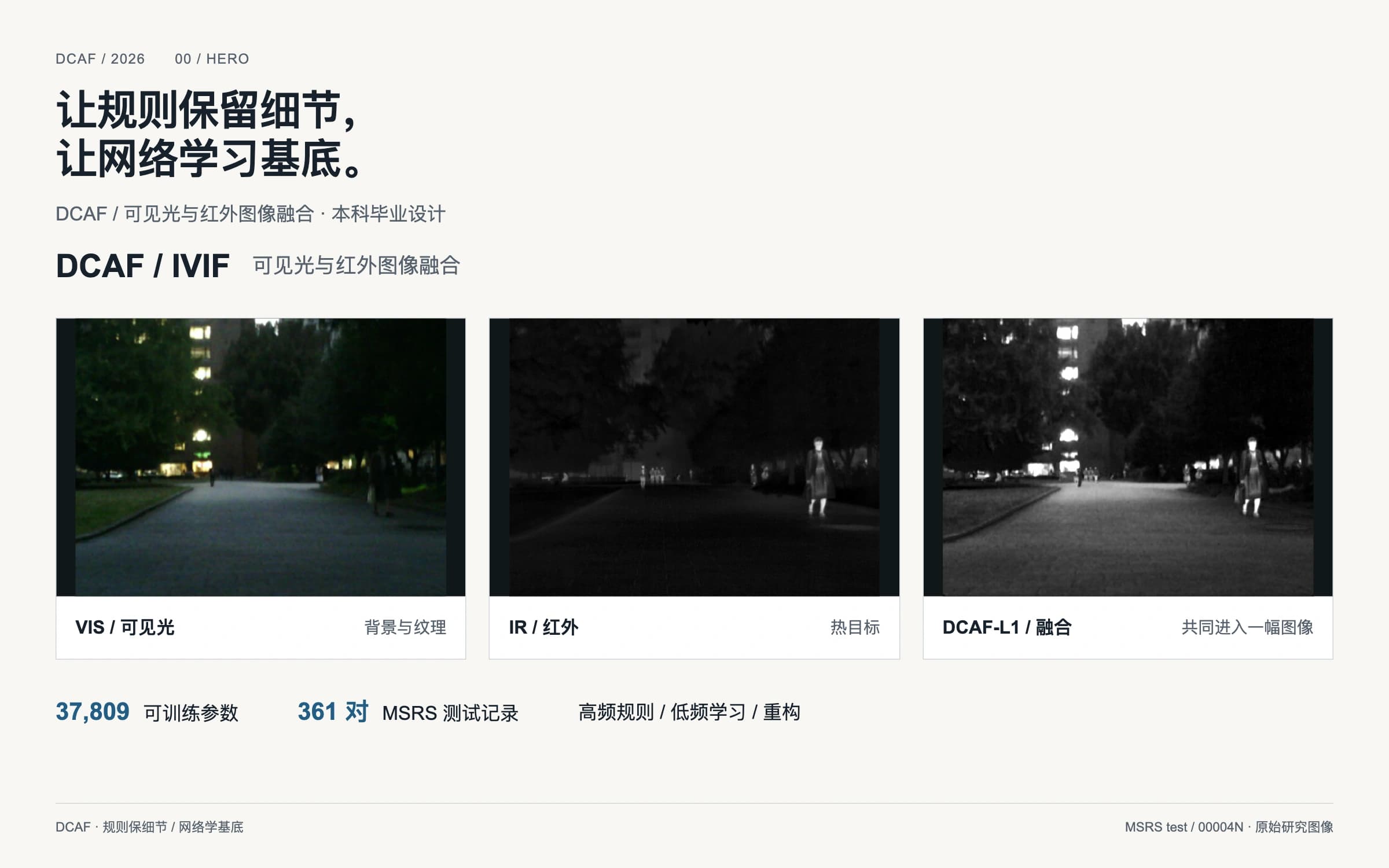
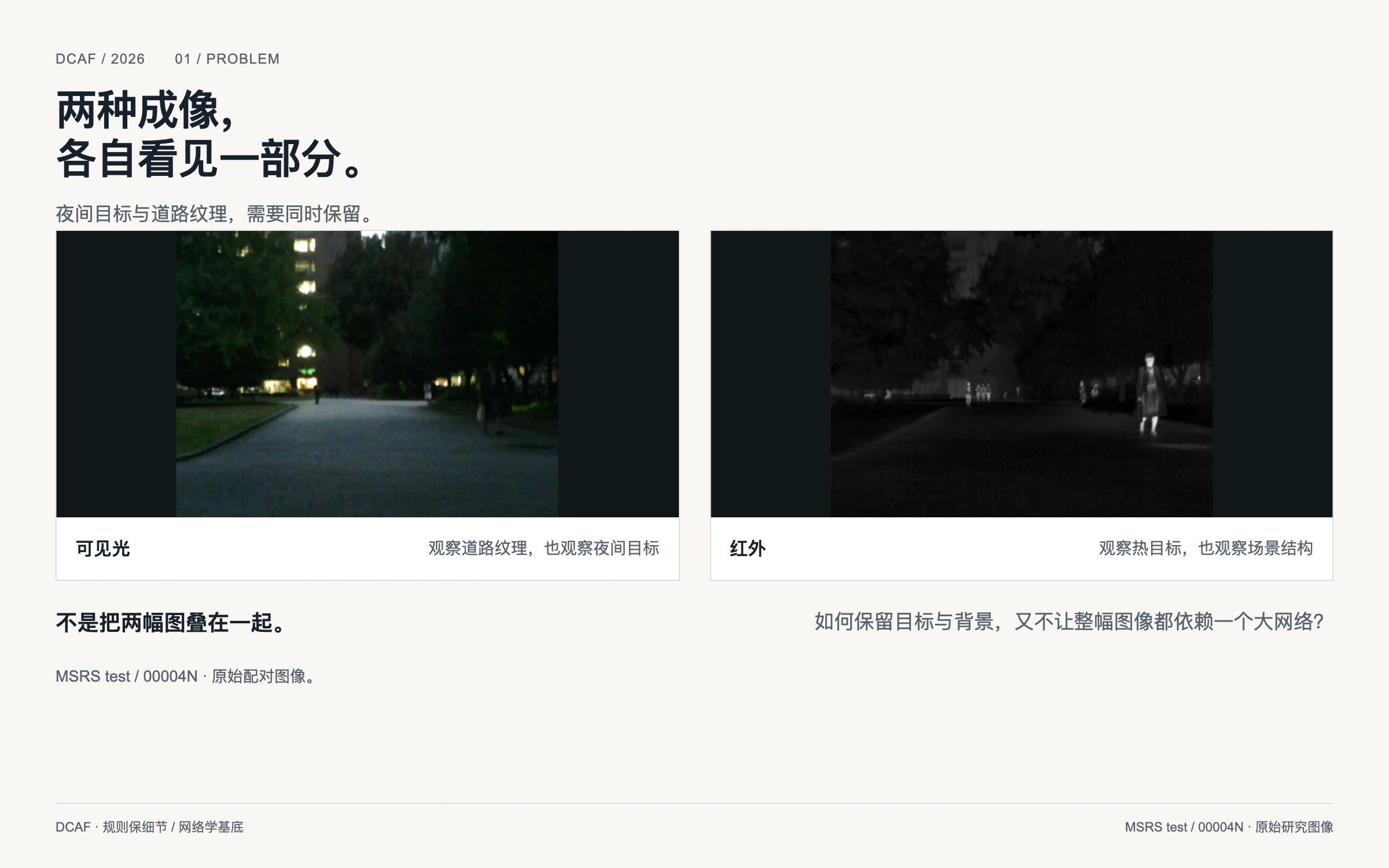
What each imaging modality misses
Visible images show scene structure but may obscure warm targets in difficult lighting. Infrared highlights thermal information while offering less texture. The research examines how these signals complement one another, beyond simply overlaying the inputs.
High-frequency rules and a low-frequency network
I decomposed the inputs into high-frequency details and low-frequency bases using a Laplacian pyramid. The detail branch selects coefficients by maximum absolute value. The learned branch concatenates both bases and applies convolution, dense connections, SE channel attention, and decoding before reconstruction. SE adapts channel weights; it is not a validated day/night classifier.
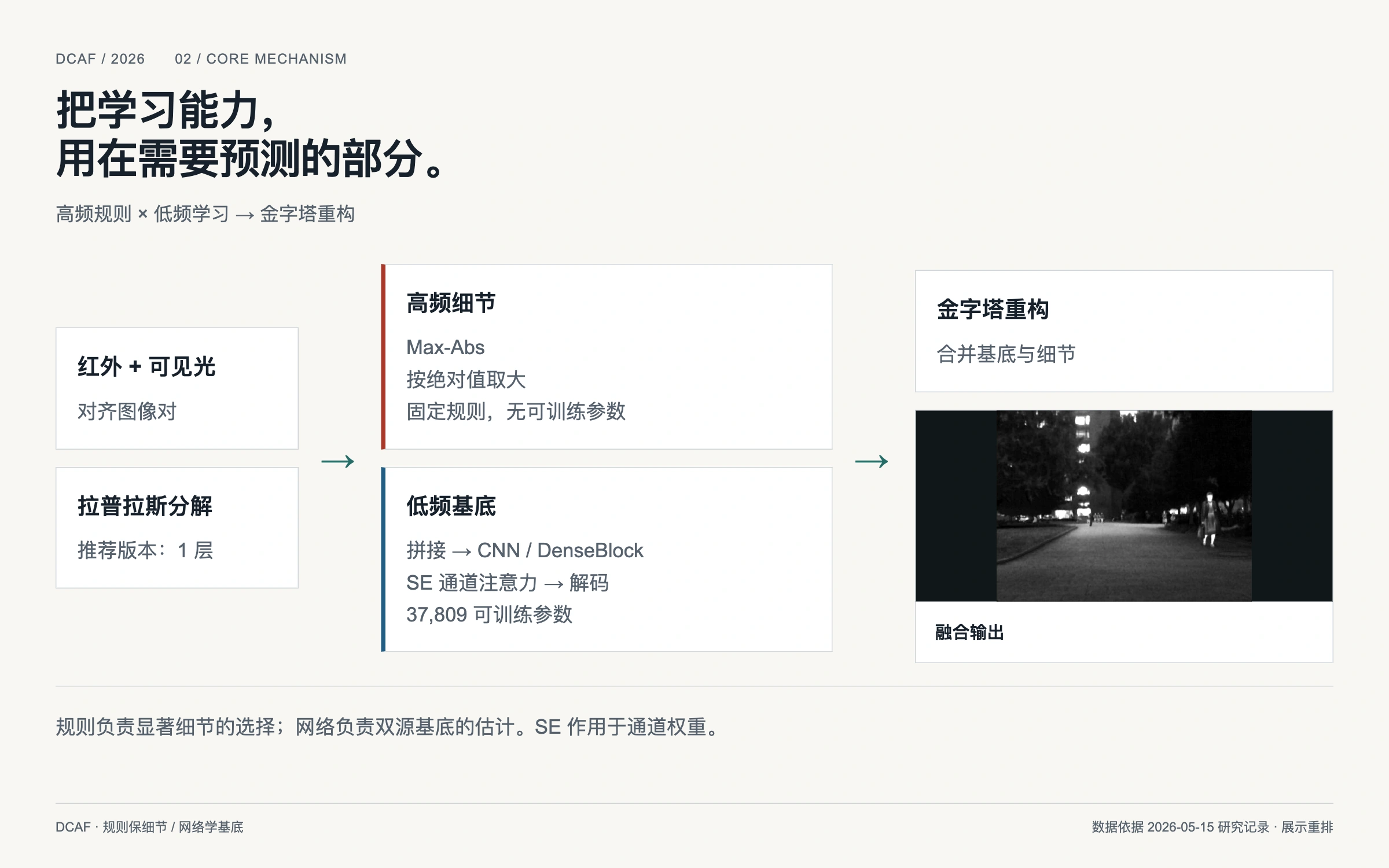
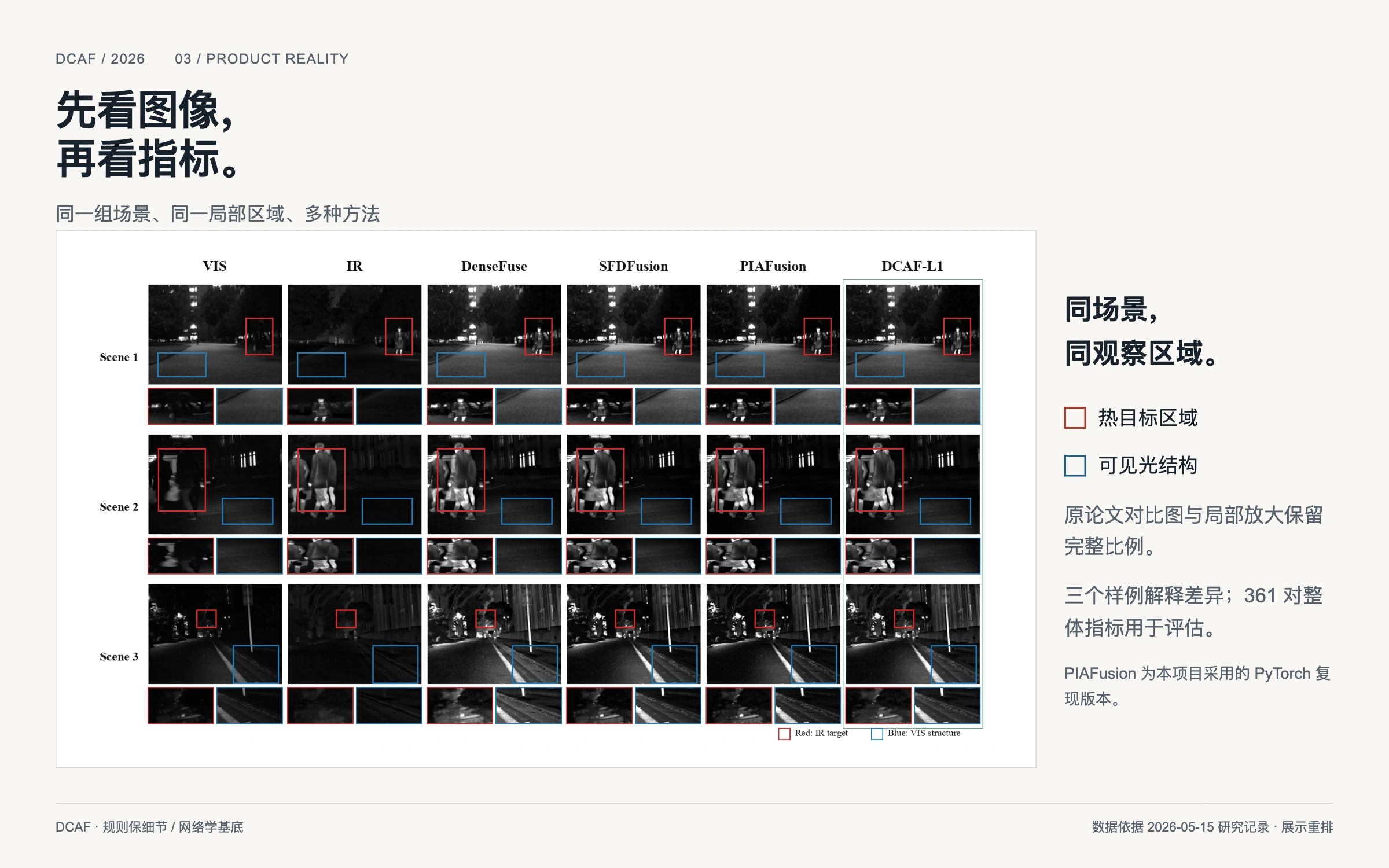
Image comparisons and aggregate metrics
The thesis compares visible, infrared, and fused outputs from multiple methods within the same scene. Red boxes focus on thermal targets; blue boxes focus on visible structure. Local views explain differences, while evaluation across all 361 pairs establishes the aggregate picture. A few attractive examples cannot replace the full evaluation.
Ablation of decomposition depth
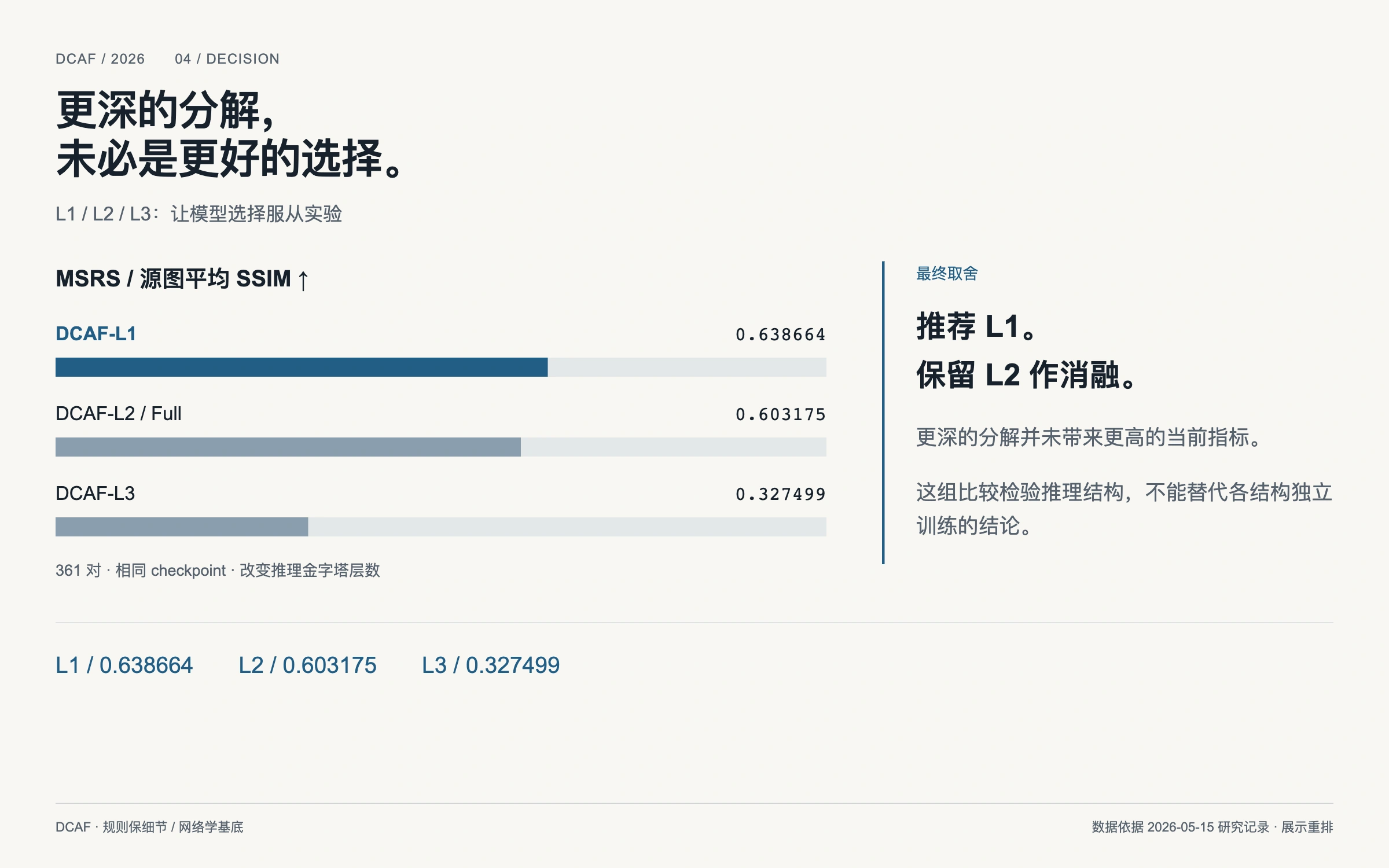
Under the recorded checkpoint and inference protocol, the MSRS source-average SSIM was 0.638664 for L1, 0.603175 for L2, and 0.327499 for L3. I recommended L1 and retained L2 as a structural ablation. This compares inference decomposition depths; it is not a universal conclusion from independently retraining every depth.
Model size and baseline comparisons
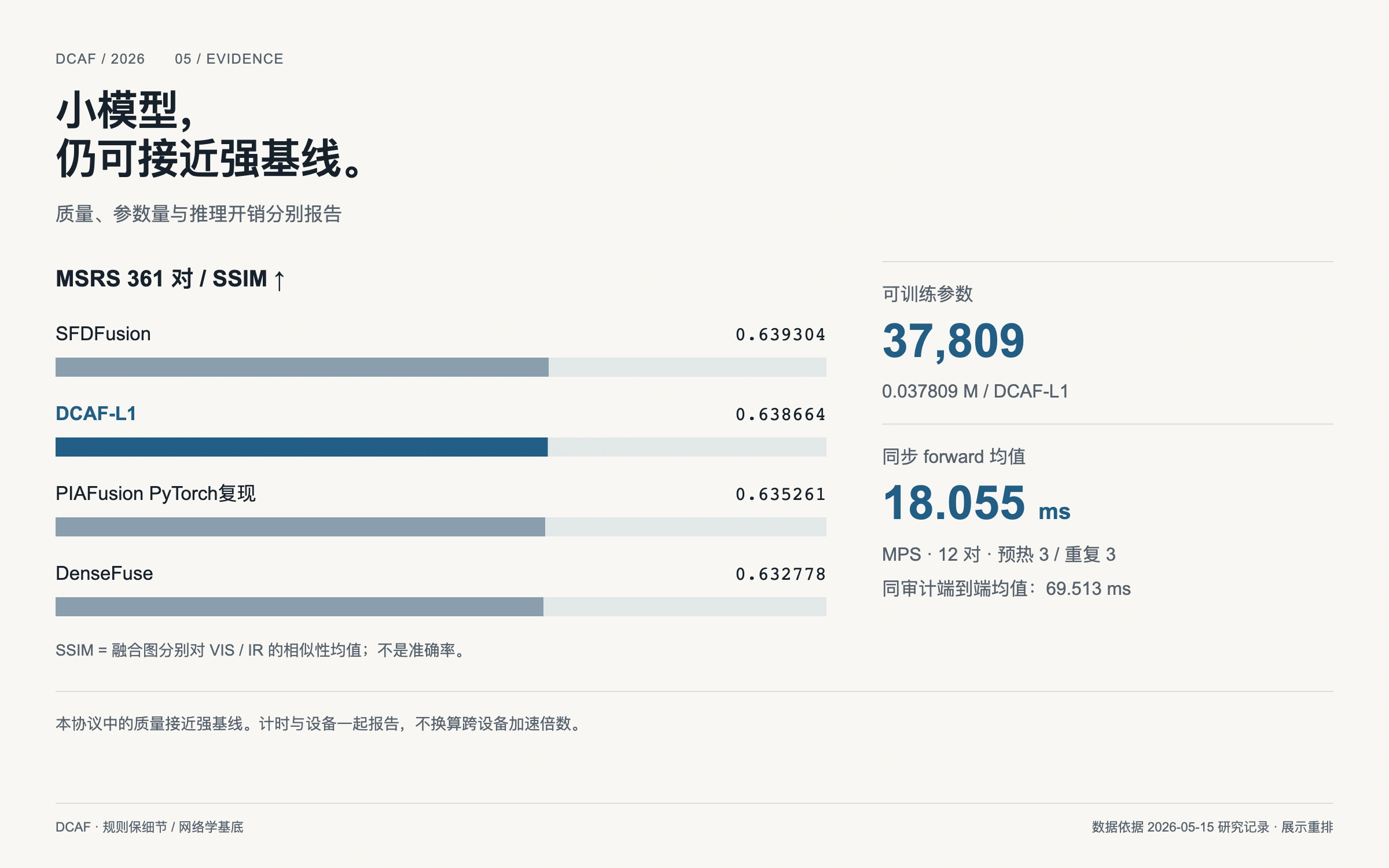
On 361 MSRS test pairs, DCAF-L1 achieved a source-average SSIM of 0.638664, close to the locally reproduced SFDFusion result of 0.639304, with 37,809 parameters. A synchronized MPS timing audit on a 12-pair subset recorded a mean forward time of 18.055 ms and end-to-end time of 69.513 ms. These measurements describe their own scope and do not establish a speedup across devices.
Downstream detection results
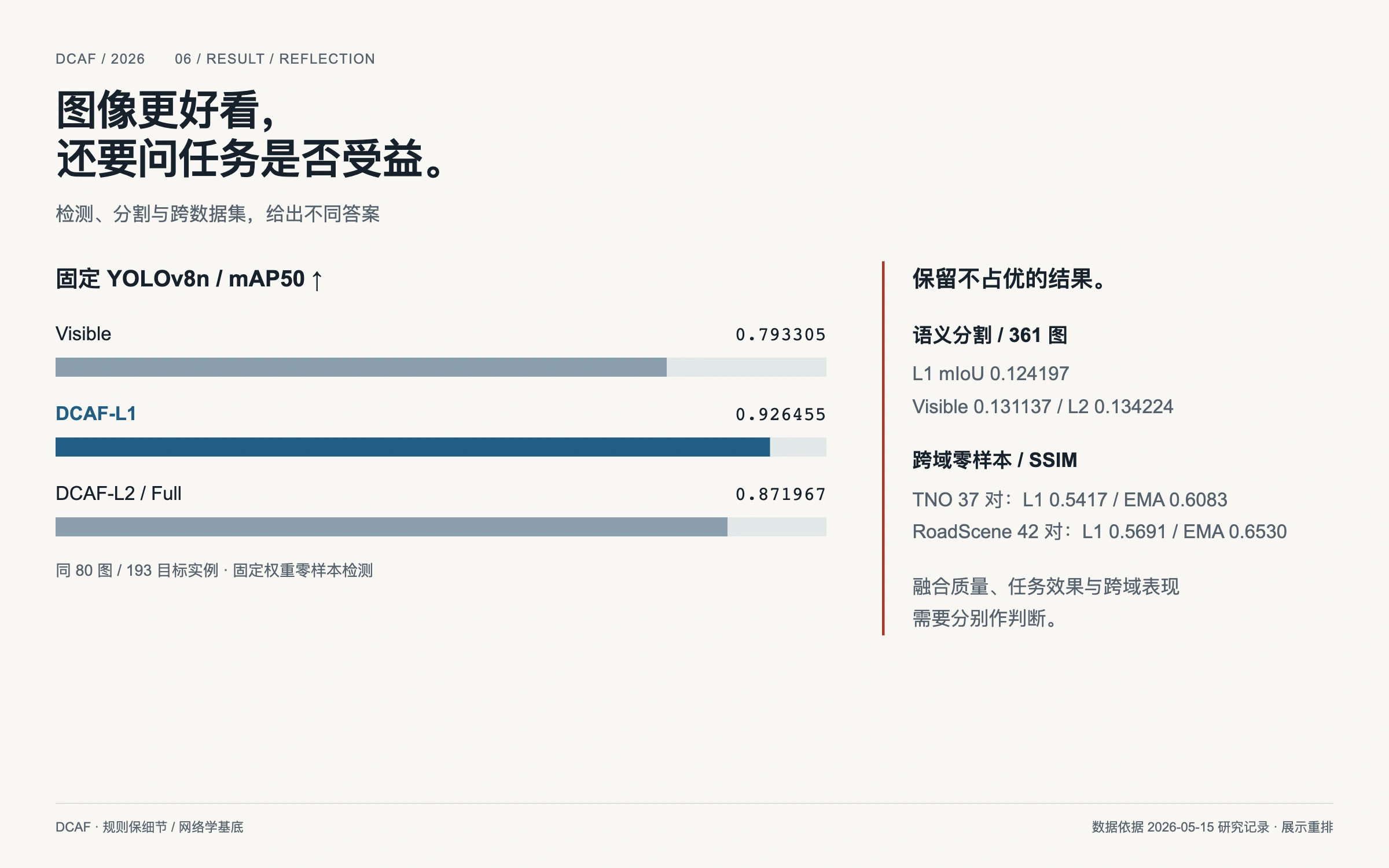
With a fixed YOLOv8n model on the same subset of 80 images and 193 target instances, DCAF-L1 inputs achieved mAP50 of 0.926455 versus 0.793305 for visible inputs. However, L1 semantic-segmentation mIoU was lower than the visible baseline, and zero-shot TNO and RoadScene SSIM remained below EMAFusion. Fusion quality, downstream performance, and cross-domain behavior therefore require separate conclusions.
Training and evaluation records
The research retained configurations, per-image records, tables, thesis versions, defense materials, and an outstanding-graduation-thesis exhibition poster. I implemented the method and experiments and turned the research decisions into a thesis and demonstration. The record also preserves unsuccessful experiments and unresolved limitations.

My part
This was my undergraduate graduation project. I implemented the method, training and evaluation workflow, baseline comparisons, ablations, downstream validation, and visual demonstration, and completed the thesis and defense materials under my supervisor’s guidance. The thesis received an outstanding graduation thesis honor. Public datasets and external baselines retain their attribution.
The choice after the experiments
I recommended DCAF-L1 while retaining deeper-structure ablations and differences across tasks. Model size, image quality, timing scope, and task outcomes need to be considered together. Deployment on edge hardware and more demanding cross-scene adaptation remain to be validated.
This case uses existing experiment images and records; explanatory architecture and data figures were rearranged for presentation. The honor is author-confirmed and the existing exhibition poster documents the research process.
Sources: MSRS dataset, SFDFusion implementation, and PIAFusion implementation.