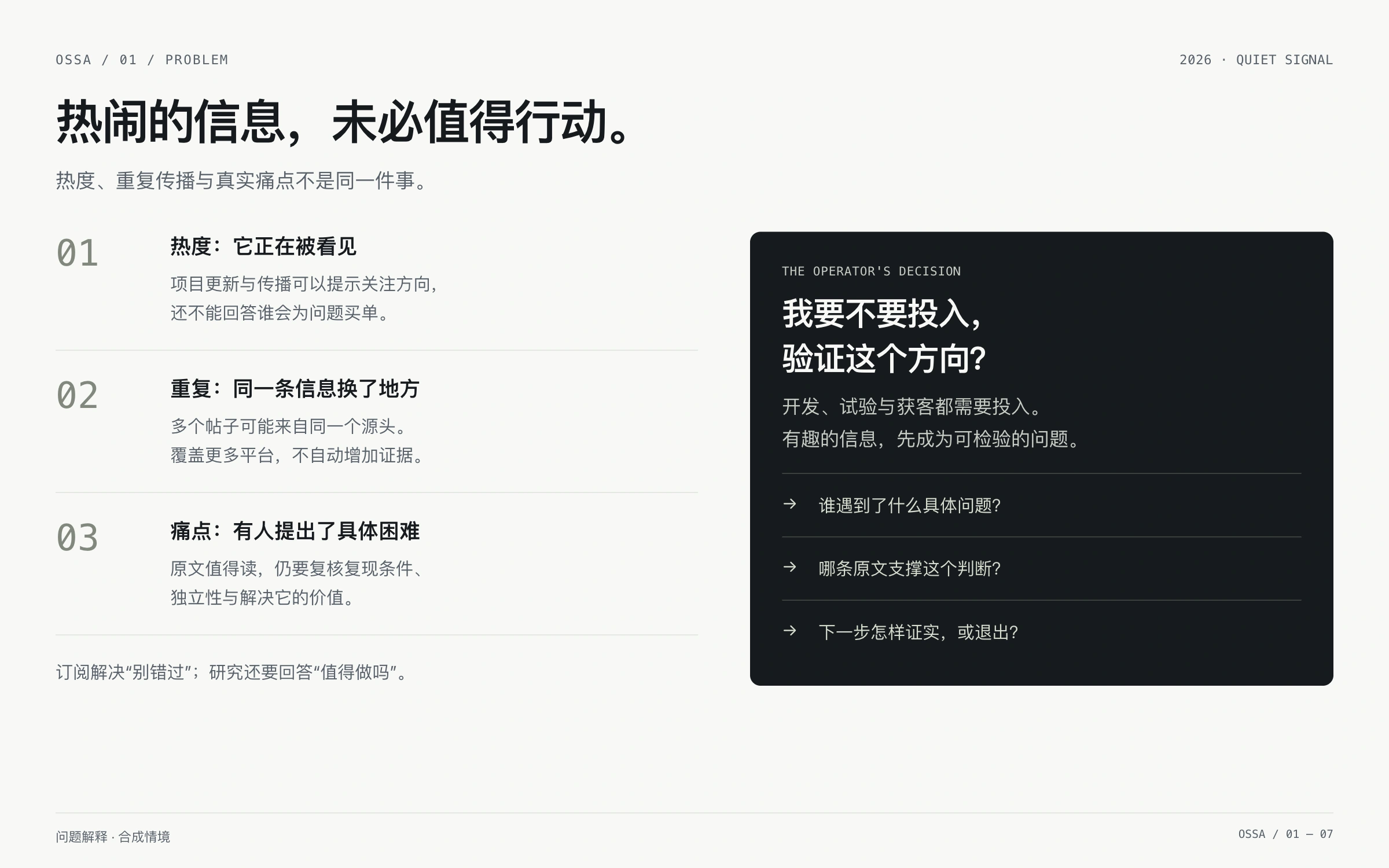
Which leads deserve another look?
Seeing a signal and deciding to invest require different evidence.
Technology releases, project discussions, and community comments can all suggest opportunities. Popularity may reflect distribution rather than demand; a complaint may describe one configuration issue. A plausible business direction still needs an identifiable problem, inspectable sources, and a way to test the hypothesis.
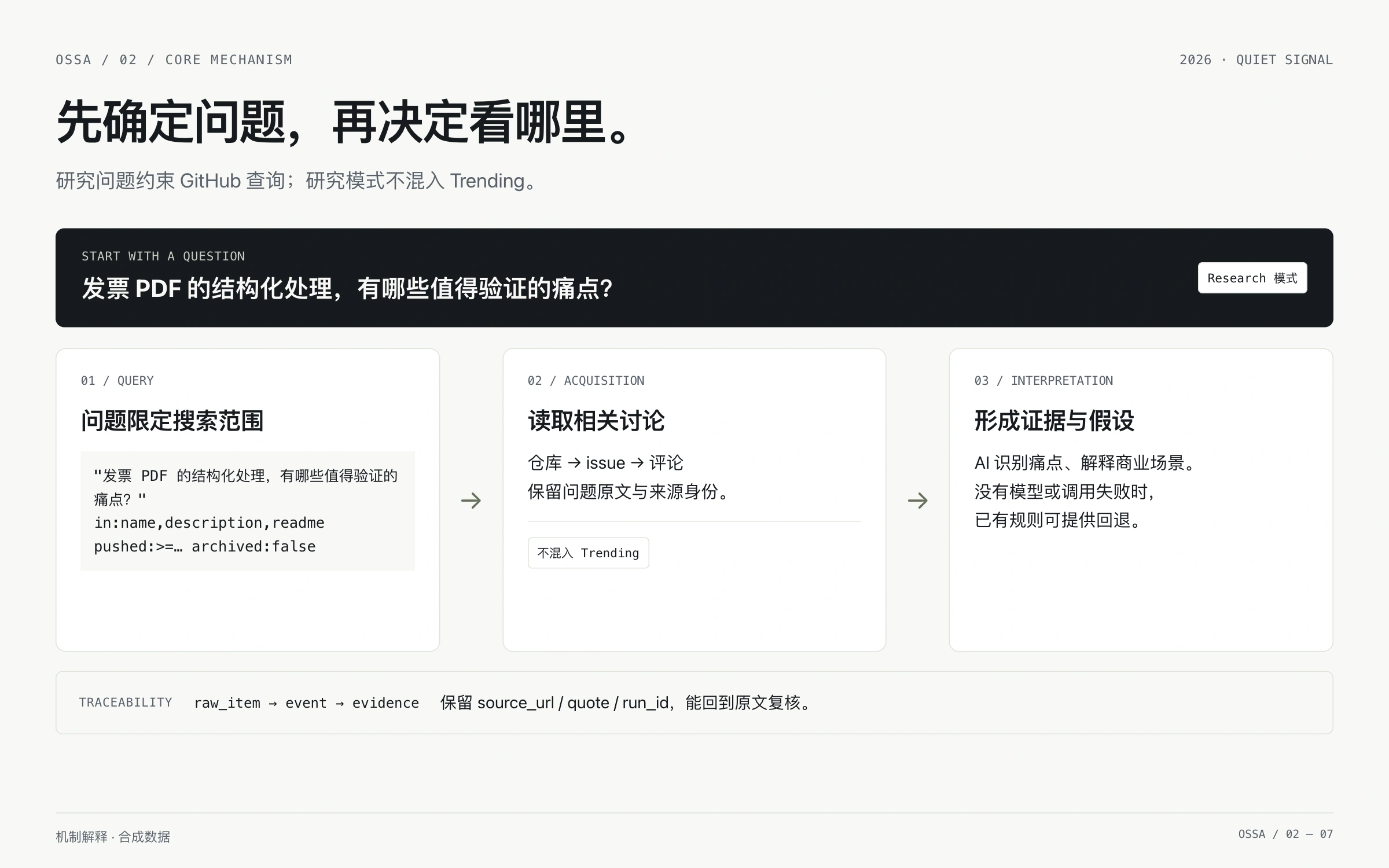
Choosing sources for a research question
The decision determines which evidence to look for.
I brought research questions into GitHub queries to limit repository searches before reading issues and comments. Research mode excludes unrelated Trending items, keeping collection focused on the current question. Results preserve original text and source identity so opportunity analysis can return to the material it used.
AI analysis and conditions for action
Separate a promising interpretation from permission to proceed.
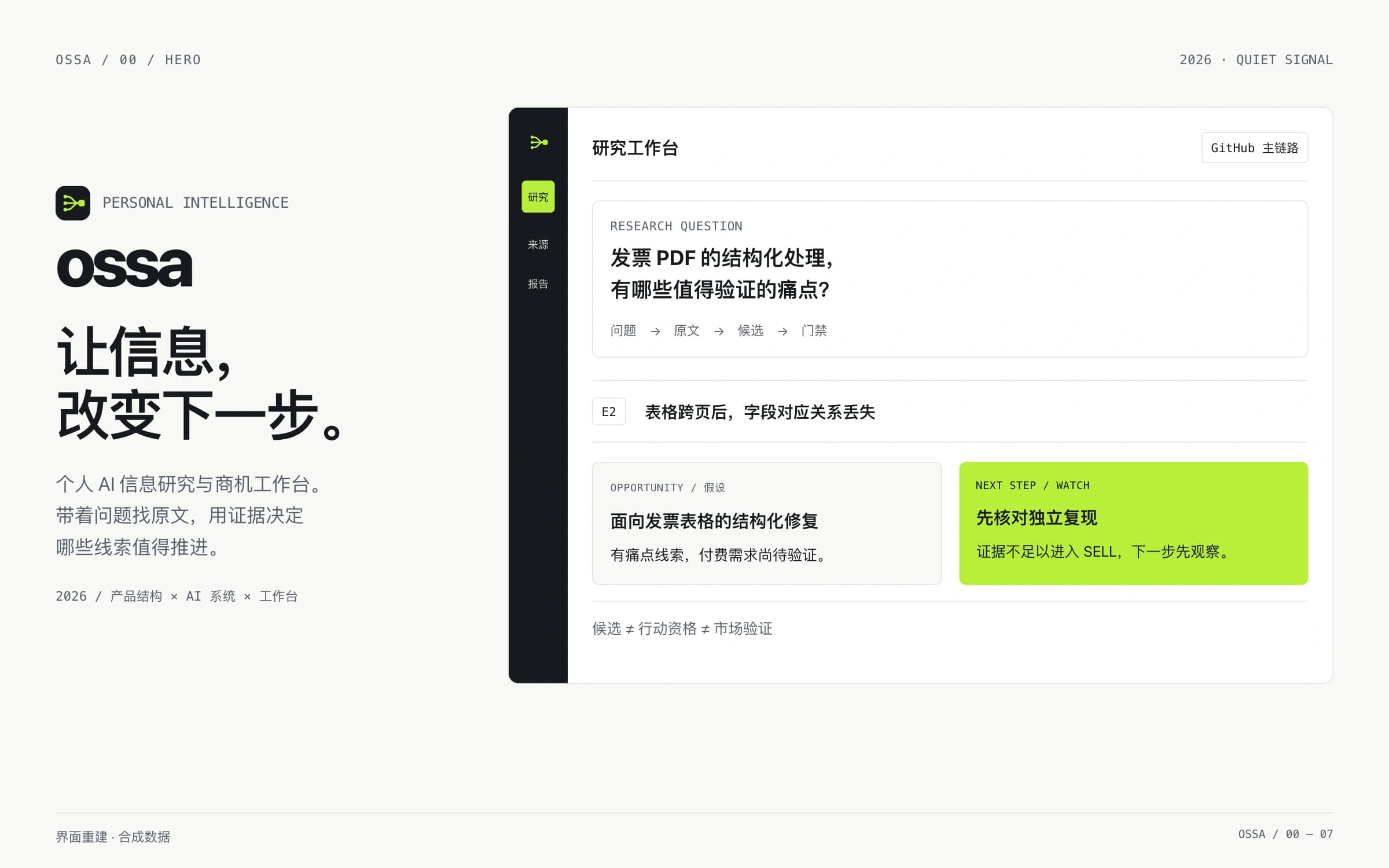
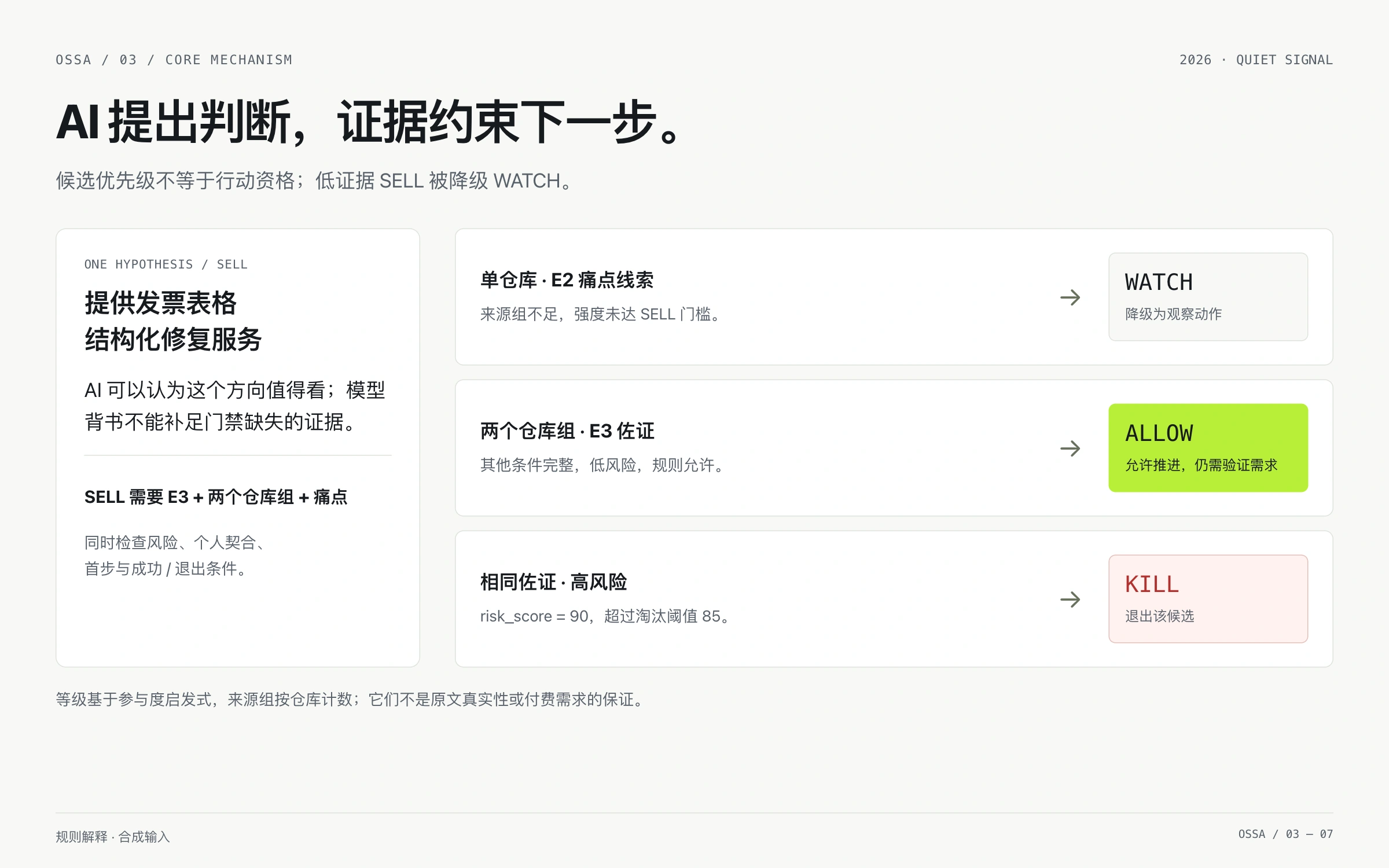
AI interprets pain points, deployment paths, and possible business contexts. Deterministic gates then inspect evidence level, repository groups, risk, and action conditions. A SELL hypothesis with insufficient evidence becomes WATCH; a high-priority model endorsement cannot fill the evidence gap. Passing the rules remains a starting point for validation.
Uncertainty and disagreement in a report
Readers can distinguish analysis, candidates, and actions.
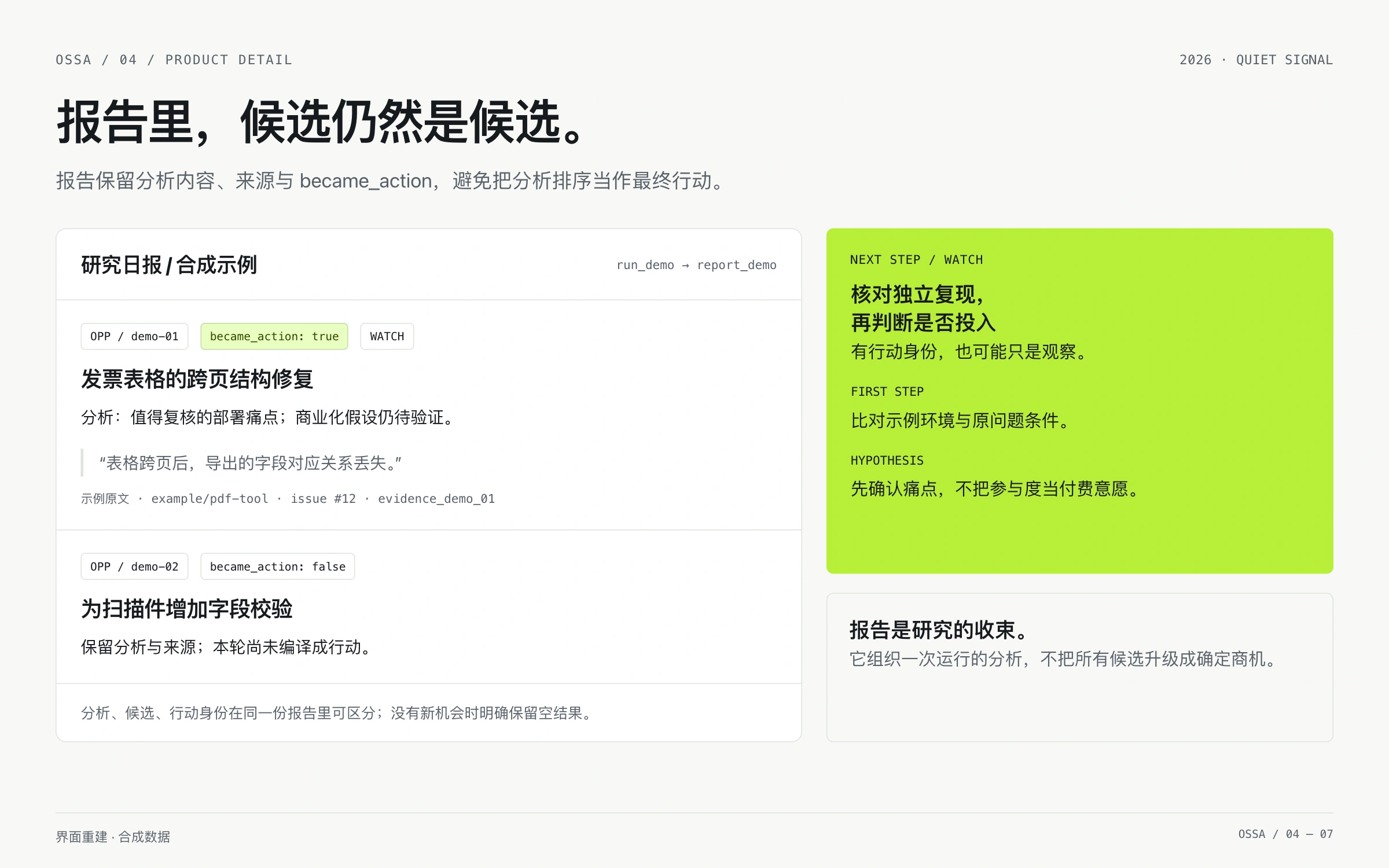
A daily report brings together opportunities, pain-point signals, and AI analysis from one run. It retains sources and whether each candidate became an action. An interesting candidate can remain a hypothesis, and a WATCH action can still have a next step. When no new opportunities appear, the report states the empty result explicitly.
What each source currently supports
Establish scope before expanding coverage.
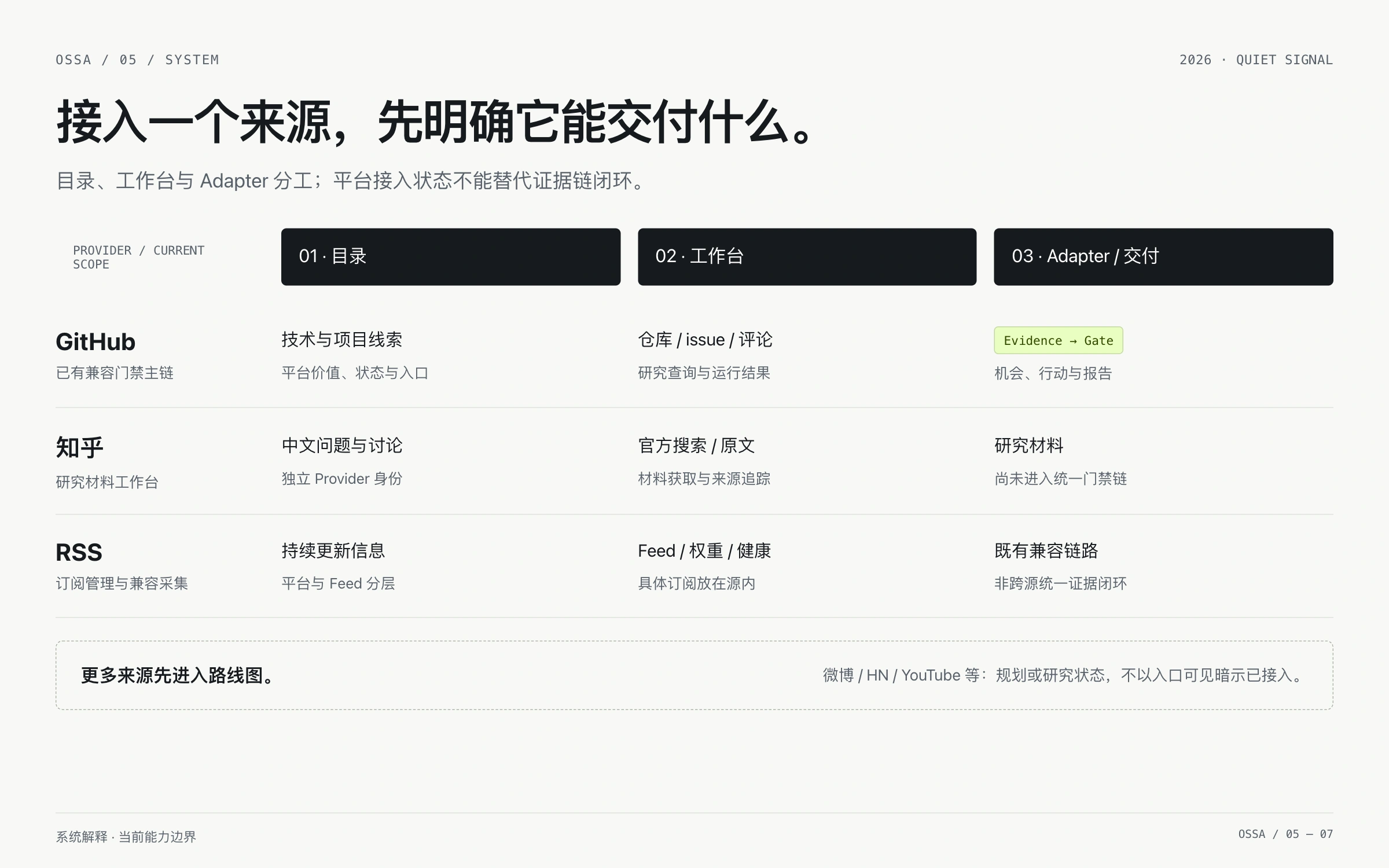
I separated signal sources into a directory, source-specific workspaces, and platform adapters. GitHub has a complete compatibility path through the gate; Zhihu provides research material, and RSS supports subscription management. Additional platforms remain on the roadmap so an entry point does not imply an unimplemented capability.
Researching one specific question
A narrower entry point changed the center of the product.
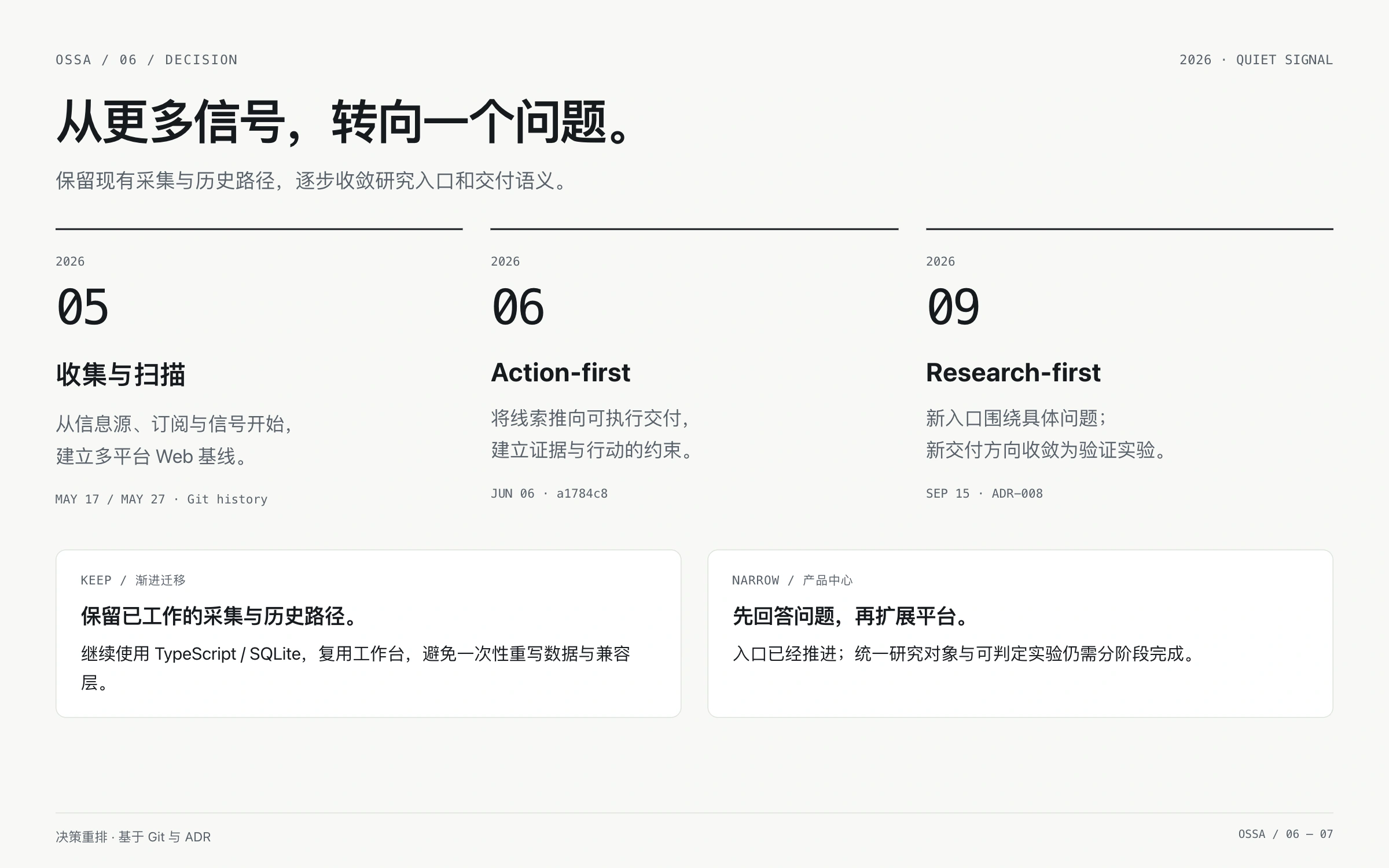
Early versions organized work around signals and action cards. By September 2026, I was narrowing the new entry point to a research question and the intended deliverable to an experiment with decision criteria. Existing collection, SQLite records, and compatibility paths remain while the new research contracts migrate incrementally.
My part
I work across Ossa’s product structure and implementation, translating an information-subscription idea into a research-question entry point, collection and evidence paths, AI analysis, eligibility gates, and daily reports. The central decision is to organize research around a specific choice and retain a validation boundary around AI-generated business hypotheses.
Further work
Information value returns to a concrete decision.
The current prototype establishes a question-led entry point, GitHub evidence gates, source layers, and daily reporting. The next direction brings unresolved questions, acquisition cost, and stopping conditions into research, ordering information by its impact on judgment. The full value-of-information and experiment-feedback loop is still being built; this is a design direction rather than a completed algorithm.
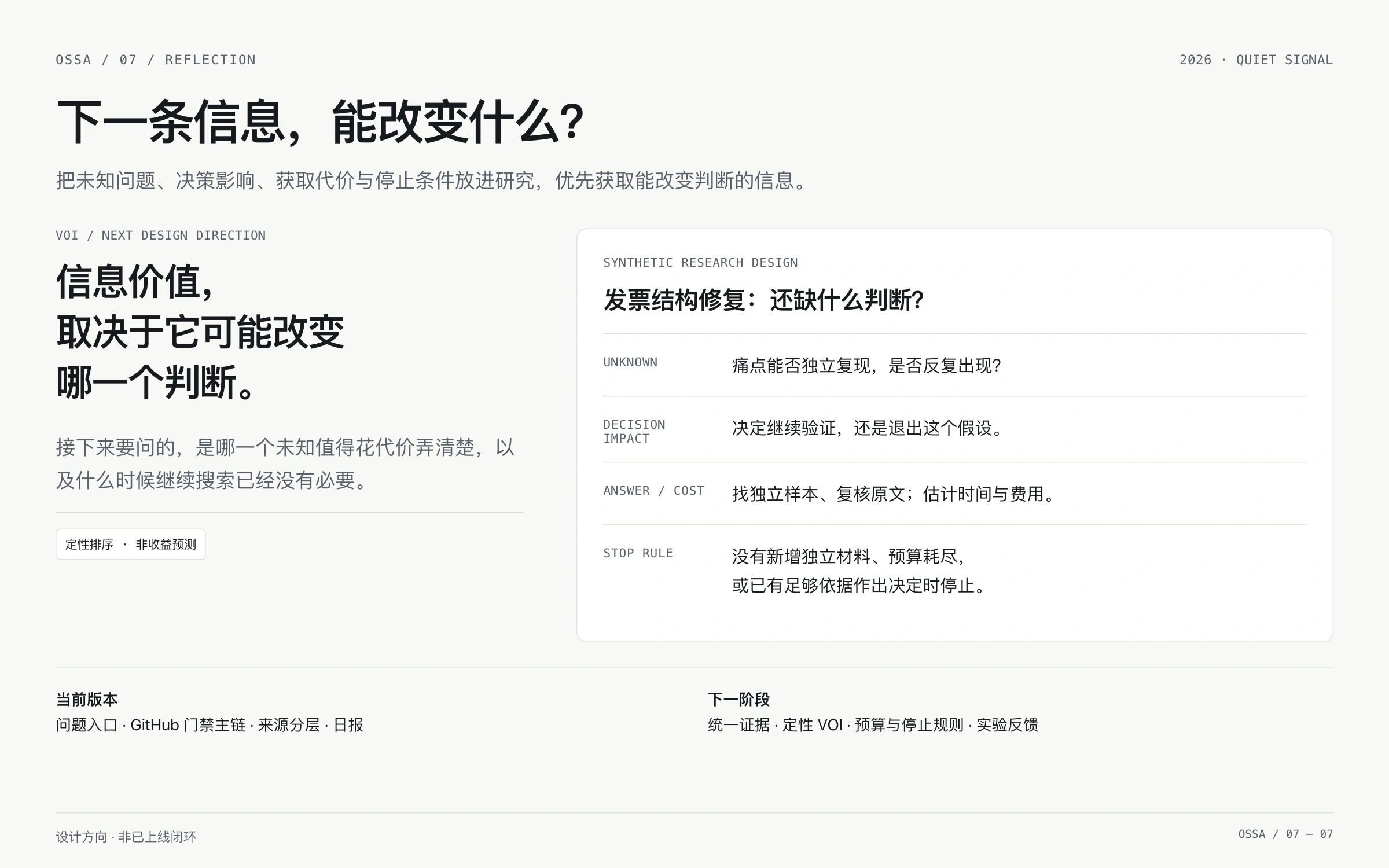
Visuals are reconstructed interfaces, mechanism illustrations, or explicitly identified design directions using synthetic business contexts. Eligibility rules explain which next steps may proceed; candidates still require validation.